
Introduction: rental is moving into the ERP
Microsoft has made rental in Dynamics 365 part of its plans. Four capability areas and a Q4 2026 target are public. The depth, and the fit for your fleet, are not.
For many years, rental was a side business for companies that make, sell or service equipment. A few spare machines went out on rent, and someone tracked them in a spreadsheet or a small separate tool.
That is changing. More companies now earn money from the use of a machine, not only from its sale. Microsoft calls this the asset as a service model.
On 9 December 2025, Microsoft published a post called Transforming how organizations run rental operations with Dynamics 365 ERP. In it, Microsoft says it is building rental capabilities into Dynamics 365. This article explains what the post says, what it does not say yet, and what you can do now.
What Microsoft announced
According to the post, the rental capabilities are in development, with release planned for the fourth quarter of 2026. Microsoft names four areas:
- Quoting and reservations. Confirm availability and turn opportunities into contracts
- Contract and pricing management. Short and long term rentals, rent to own, and seasonal pricing
- Inspections orchestration. Coordinate inspections at delivery, transfer and return
- Billing and invoicing. Tied directly to rental activity, for better accuracy and less reconciliation.
For finance teams, the area to watch is billing tied to rental activity. It decides if the invoice matches what really happened in the field.
The post also says these capabilities will work together with Dynamics 365 Finance, Supply Chain Management, Project Operations and Field Service. They run on the Microsoft Cloud, so customers, ISVs and partners can extend them with AI agents, using MCP and Microsoft Copilot Studio.
Why now?
Microsoft points to the size of the market. It cites the American Rental Association and independent analysts: the North American equipment and tool rental market will exceed $80 billion. Global rental and leasing revenue is already well above $500 billion a year.
Microsoft also names the problem it wants to fix. Rental processes often run across separate systems for quoting, dispatching, billing and finance. The post links this to idle time, slow handoffs, lost margin and a weak customer experience.
The problem: the direction is public, the fit is not
The post is a statement of direction. It is not a product guide. That is normal for an announcement, but it leaves real questions open:
- How deep each area goes. “Contract and pricing management” can mean a simple daily rate. It can also mean day, week and month rates with hour limits, overtime and discounts. The post does not say which
- How it fits your type of fleet. A company that rents 300 serialized excavators has different needs than one that rents 20,000 pieces of fencing
- Licensing and price. The post does not cover them
- Regions. The post does not say which countries come first
- Moving from today’s tool. The post does not say how to move from the rental system you use now.
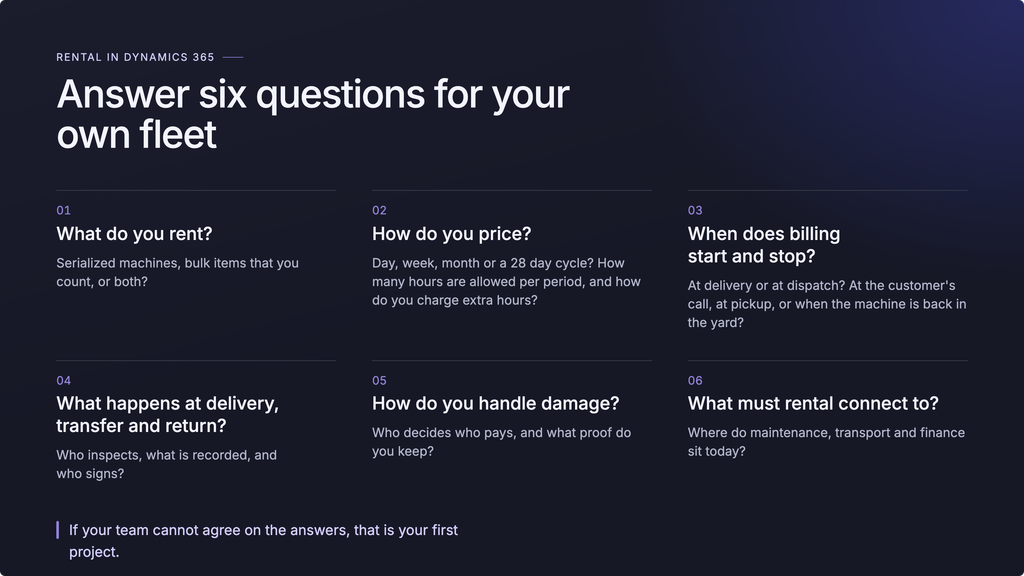
The solution: answer six questions for your own fleet
You do not need release notes to start. These six questions follow the four areas Microsoft named. Answer them for your business now:
- What do you rent? Serialized machines, bulk items that you count, or both?
- How do you price? Day, week, month or a 28 day cycle? How many hours are allowed per period, and how do you charge extra hours?
- When does billing start and stop? At delivery or at dispatch? At the customer’s call, at pickup, or when the machine is back in the yard?
- What happens at delivery, transfer and return? Who inspects, what is recorded, and who signs?
- How do you handle damage? Who decides who pays, and what proof do you keep?
- What must rental connect to? Where do maintenance, transport and finance sit today?
If your team cannot agree on the answers, that is your first project. No software will answer these for you.
When a customer asks about rental in Dynamics 365, these six questions are a better first meeting than a feature list. They show the customer where their real complexity is.
Results: what you get from doing this early
- You can judge any rental solution against your own rules, not against a demo script
- You find gaps early, while there is still time to plan for them
- Finance and operations agree on the rules before a project starts, not in the middle of it.
Get ready before the release
If you rent out equipment and run Dynamics 365, or plan to, talk to Reach. We help teams write down their rental rules, so they are ready to make a clear decision when the time comes.

Stop rebuilding your rental rules by hand.
Reach can help you get your fleet ready for rental in Dynamics 365 governed, tested, and production ready before the release.
This is the first of four articles on rental in Dynamics 365. Next: Rental is not an inventory problem, Where rental revenue leaks, and Native rental or a rental add on.
FAQ for Rental in Dynamics 365
On December 9, 2025, Microsoft published a post about adding rental capabilities to Dynamics 365. It covers four areas: quoting and reservations, contract and pricing management, inspections orchestration, and billing and invoicing. Release is planned for Q4 2026.
No. The post is a statement of direction, not a product guide. The capabilities are still in development, so details on depth, pricing, and regional rollout are not available yet.
Microsoft says the new rental capabilities will work alongside Finance, Supply Chain Management, Project Operations, and Field Service. They run on the Microsoft Cloud, so partners and ISVs can extend them with AI agents using MCP and Copilot Studio.
Microsoft points to market size. It cites the American Rental Association and other analysts showing the North American equipment and tool rental market will pass $80 billion, with global rental and leasing revenue already above $500 billion a year.
Many rental businesses run quoting, dispatching, billing, and finance in separate systems. Microsoft links this setup to idle time, slow handoffs, lost margin, and a weaker customer experience.

Alek is a Senior Dynamics 365 F&O Consultant at Reach, helping businesses get more value from their ERP systems. His work spans three core areas: Manufacturing, Master Planning (MRP), and Asset Management. He brings experience from multiple rollouts and implementations across automotive, mining and drilling, and high tech industries.