
Introduction: you do not sell the machine; you sell its time
A rental company does not sell a machine. It sells time on a machine. That one fact changes where the whole process has to live. The fleet must be treated as assets that move, not stock on a shelf. In rental inventory.
When a distributor sells a pallet of filters, the job ends when the goods leave the warehouse. When a rental company sends out an excavator, the job is just starting. The machine will work for weeks, come back, get checked, get fixed and go out again. Over its life, that can happen a hundred times or more.
So the main question in rental is not “how many do I have?” It is “what is happening to this machine right now?”
The problem: when the fleet lives in rental inventory
Rental inventory is built to answer one question well: how many do I have, and where? For rental, that is the wrong first question.
You can see the signs in many companies:
- The system says there are 12 excavators of one type in a branch. Nobody can tell which three are on rent, which two wait for repair, and which one is promised to a customer for Monday
- Hours on the machine live in a spreadsheet or a telematics portal, not next to the contract that should bill them
- Finance sees a fixed asset. Operations sees a stock item. Nobody sees one machine with one story
- Utilization is a monthly report that someone builds by hand.
The root cause is simple. An item record describes what a machine is. It does not describe which machine it is, or what is happening to it.
The solution: put the asset at the center
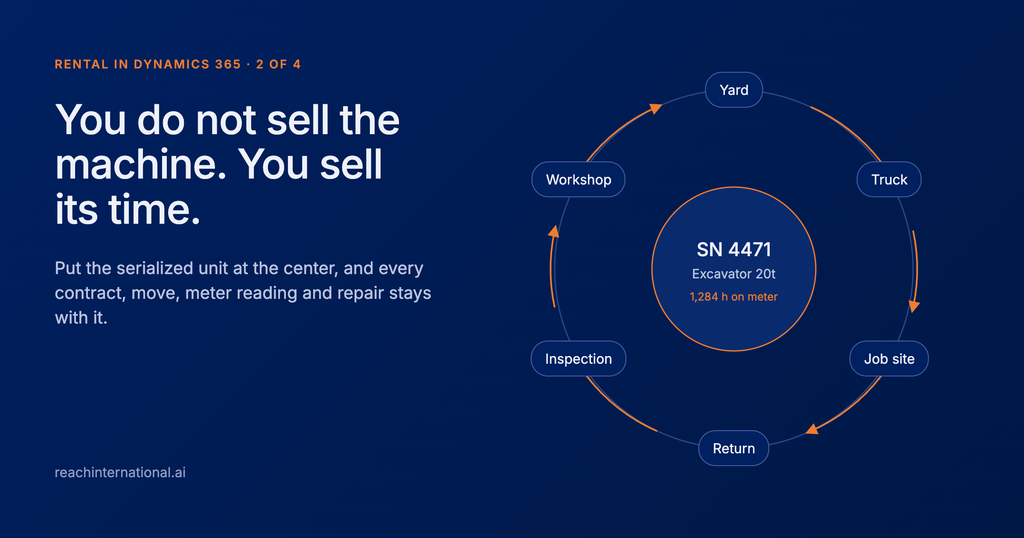
In rental, the main record is the single machine, the serialized unit. Everything else connects to it. For every machine, you should be able to answer at any time:
- Is it free, booked or on rent?
- Where is it: in the yard, on a truck or on a job site?
- Is it ready to go out, or waiting for inspection or repair?
- How many hours has it worked, and how many since the last service?
- What did it cost, and what has it earned?
Six ideas make this work in practice.
1. Quote a class, deliver a unit. Customers ask for “a 20 ton excavator”, not for a serial number. So price and availability work at the class level. But when the machine leaves the yard, the contract must point to one specific unit. That is how you know whose hours to bill and whose damage to check.
2. The machine carries its own history. Every contract, move, meter reading, inspection and repair stays with the unit. When a customer disputes damage, you look at one record, not five systems.
3. Attachments are assets too. A bucket, a breaker or a set of forks can go out with one machine, come back with another, or be rented alone. Track them as their own assets, linked to the machine they work with, not as a line of stock.
4. Rental and maintenance share one calendar. A machine in the workshop is not available, even if it stands in the yard. Service planning must see rental bookings, and rental must see service plans. Meter hours drive both: the bill and the next service.
5. Finance sees the same machine. Each unit is usually a fixed asset. It loses value over time and earns rent. When operations and finance look at the same record, you can see what each machine really earns against what it costs to own.
6. Every move is recorded. A machine goes from the yard to a truck, to a job site, maybe to a second site, back to the yard and into the workshop. Each move should be recorded on the machine, with the time, the place and the meter reading. Stock on a shelf does not move like this. A rental asset almost never stops.
Where inventory still fits
This does not mean inventory has no place. Scaffolding, fencing, road barriers and small tools are usually counted, not tracked one by one. For these, quantity logic is the right choice. Spare parts and consumables are real inventory too.
Most fleets have both. The real design work is to decide where the line is: which items you track as single assets, and which you count.
What this means in Dynamics 365
If you run Dynamics 365, ask one question early in your design: where does each machine live? The same unit can show up as a serialized item in Supply Chain Management, as an asset in Asset Management, and as a fixed asset in Finance. To get one machine with one story, these records must be linked, and your team must agree which one leads.
Results: what changes when the asset is at the center
- You can answer “can I rent this machine on Monday?” in seconds, and trust the answer
- Hours and damage connect to the right contract, so billing and recovery are cleaner
- Utilization becomes a live number, not a monthly project. Two measures matter most. Time utilization: days on rent against days available. Dollar utilization: rental revenue against what the fleet cost to buy
- Buy and sell decisions get easier, because you can see which classes earn and which ones sit.
Call to action: test your system with one serial number
Take the five questions above and check which ones your system can answer today for a single serial number. If the answer is “not many”, your fleet is living as stock on a shelf. Reach is happy to walk through it with your team.
This is the second of four articles on rental in Dynamics 365. Previous: What Microsoft has announced for rental in Dynamics 365. Next: Where rental revenue leaks.

Stop rebuilding your rental rules by hand.
Reach can help you get your fleet ready for rental in Dynamics 365 governed, tested, and production ready before the release.
Inventory answers “how many do I have.” Rental needs to answer “what is this specific machine doing right now.” Standard inventory logic treats machines as interchangeable stock, which hides status, location, and history at the unit level. This is why rental businesses need asset centric tracking, not item counting.
A serialized item identifies which unit you are talking about. An asset record tracks what happens to that unit over time, such as hours worked, service history, and financial value. In a well designed system, these connect to the same machine instead of living in separate, disconnected records.
No. Small tools, scaffolding, fencing, and road barriers are usually fine as counted inventory. Larger serialized equipment, such as excavators or loaders, should be tracked unit by unit. The right design separates the two instead of forcing everything into one model.

Alek is a Senior Dynamics 365 F&O Consultant at Reach, helping businesses get more value from their ERP systems. His work spans three core areas: Manufacturing, Master Planning (MRP), and Asset Management. He brings experience from multiple rollouts and implementations across automotive, mining and drilling, and high tech industries.