
Most acquisition plans are thorough about legal and commercial detail and almost silent about finance integration.
The result is familiar. The deal closes, and finance inherits a set of books in an unfamiliar system, a chart of accounts that does not match yours, a bookkeeper who may or may not be staying, and a leadership team that wants consolidated numbers by the end of the month.
The work then happens under time pressure, which is the worst condition for decisions you will live with for years. These five questions take an afternoon to answer before close and save months afterwards.
1. What does day one reporting actually need to show?
Start at the end. Write down the first consolidated report leadership will ask for after close, and the date they will ask for it.
That single answer drives almost everything else. If day one only requires a consolidated profit and loss by entity, you can run the acquired business on its existing system for a period and combine at a summary level. If leadership expects performance by location and service line across the whole group, you need the dimension structure agreed before anything is migrated.
Most teams discover the harder requirement a month after close, when it is expensive to meet.
2. What structure are we actually creating?
Settle how the acquired business will be represented. Is it a separate legal entity that stays separate, a legal entity that will be merged later, or a division of an existing entity?
Then settle how money will move between the entities, because intercompany activity is where close effort accumulates. Shared services charges, management fees, and cash sweeps all create intercompany entries. Decide now whether these will be posted as formal intercompany transactions or handled as journals, because the two approaches are very different to maintain.
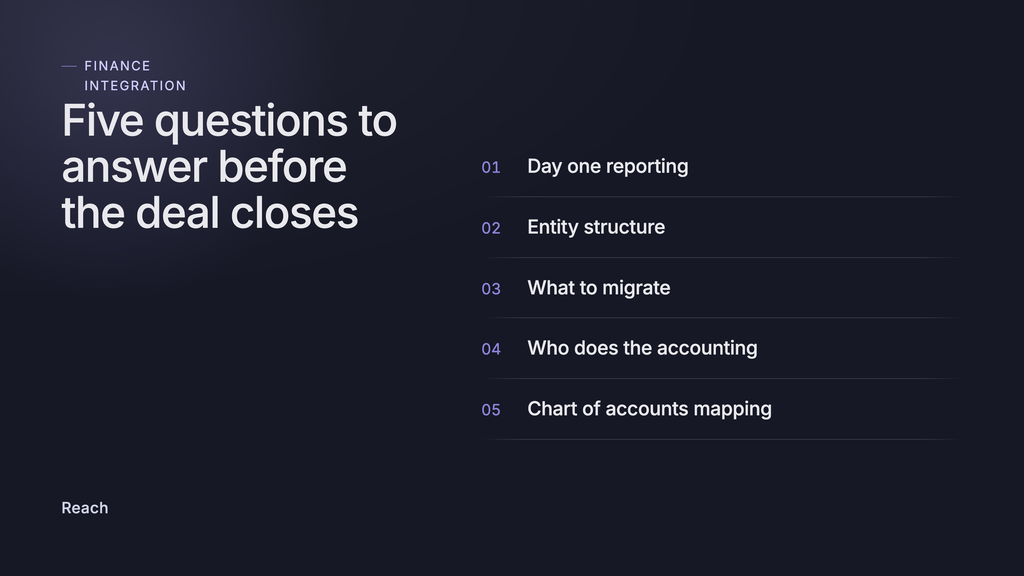
3. What are we migrating, and what are we leaving behind?
The instinct is to bring everything. It is almost always the wrong call.
A workable default is to bring opening balances, open items such as receivables and payables, master data for customers and vendors, and a defined number of years of summary history. Everything older stays accessible in the original system in read only form, or in an export.
Decide this before close, because the answer affects cost, timeline and how much cleanup the acquired data needs. Migrating five years of transactional detail from an unfamiliar system is a project on its own, and the detail is rarely used once it has been moved.
4. Who is doing the accounting on day two?
There are three common patterns. The acquired bookkeeper stays and keeps running their system for a transition period. Your team takes over immediately using the existing system. Or you cut over to your system at close.
Each is defensible. What causes trouble is not choosing. If nobody has been told explicitly who posts the first journal after close, the first month tends to produce two incomplete sets of books rather than one complete set.
Retention matters here more than people expect. The person who understands the acquired business accounting detail is often one bookkeeper, and they frequently leave shortly after a transaction.
5. How will their chart of accounts map to ours?
This is the question most often deferred and most expensive to defer.
Build the mapping before close, even roughly. Put their accounts in one column, yours in the next, and the dimension values that should be applied in the third. Doing this exercise surfaces the real differences in how the two businesses have been tracking things, which is information you want before you own them.
If your own structure already struggles to absorb a new entity, that is worth knowing now. A chart of accounts that needs a redesign for every acquisition is a structural constraint on your growth plan, not an accounting detail.
What good looks like
Groups that handle this well tend to build an onboarding playbook after their second or third acquisition. It is usually a short checklist: the entity setup steps, the standard chart of accounts and dimensions, the data to request during diligence, the bank and payroll connections, the first month reporting pack, and who does what in which week.
The playbook is more valuable than any individual decision inside it, because it converts a scramble into a routine. If you expect to make three more acquisitions, it is worth the afternoon.
The honest limitation. A playbook does not survive a genuinely different business. If you buy something with a different revenue model or regulatory profile, expect to revisit the dimension design rather than force the new business into a structure that was not built for it.
Common questions
How much of this can we do before close? All five questions, in draft. You usually have enough from diligence to map the chart of accounts and agree the structure, even if details change.
What if the acquired business uses a system we do not know? Request a trial balance, a chart of accounts export and a list of open items during diligence. Those three files tell you most of what you need, whatever the system.
Should we standardize everything immediately? No. Standardize the chart of accounts and dimensions, because those drive reporting. Leave operational differences alone until the business has settled.
Key takeaways
- Start from the first consolidated report leadership will ask for, and work backwards
- Settle entity structure and intercompany handling before close, not after
- Migrate opening balances, open items and limited history. Leave the rest accessible elsewhere
- Name explicitly who posts the first journal after close
- Map the chart of accounts during diligence, because the exercise reveals how differently the two businesses think
- After the second or third deal, write the playbook. It converts a scramble into a routine.
Need help?
If you have an acquisition in progress and want a second pair of eyes on the finance integration plan, we are glad to look at it. Reach works with groups that are buying regularly and need the next one to be easier than the last.