
Nobody puts manual consolidation in the budget.
There is a line for software, a line for the audit, a line for salaries. There is no line that says “148 hours a year spent combining company files in Excel“, even though for many finance teams that is the single largest recurring cost in the department.
This matters because the case for changing systems usually fails on the wrong comparison. Teams compare the price of new software against the price of old software, decide the new one costs more, and stop. The actual comparison is new software against the hours you are spending today to work around not having it.
This article shows you how to calculate that number for your own team, and which parts of it people consistently leave out.
Where the time actually goes
When teams track this honestly, the hours usually sit in six places:
- Exporting and reformatting. Pulling trial balances from each file, lining up accounts that were set up differently in each one, and fixing the formatting so they stack
- Eliminating intercompany activity. Finding transactions between your own entities and backing them out, usually by hand, usually from memory
- Reconciling differences. Chasing the variance that appears because one entity posted something late or categorized it differently
- Rebuilding the reporting pack. Recreating the same schedules each month because the source data arrived in a slightly different shape
- Answering follow up questions. Someone asks why a number moved, and answering means going back into three separate files
- Fixing the workbook. Broken links, shifted ranges, a tab someone added, a formula that stopped pointing where it used to.
None of this is accounting. It is data logistics, performed by people you hired for their judgment.
How to calculate your number
Do this over one close rather than from memory, because memory understates it every time.
- For one month, ask everyone involved in the close to log hours against the six categories above. Include the people who only help a little, because that is where the time hides
- Total the hours and multiply by loaded salary cost, which is salary plus benefits and employer taxes, divided by working hours. For many finance teams this lands somewhere between 50 and 120 dollars an hour
- Multiply by twelve, then add the extra load at quarter and year end
- Add the cost of any outside help you pay for during close or audit preparation that exists because the data is fragmented.
An illustrative example, not a benchmark. A finance team of four logs 26 hours across the close on those six categories. At a loaded cost of 75 dollars an hour, that is 1,950 dollars a month, or roughly 23,400 dollars a year, before quarter end and audit work. Your figures will differ. The point is to produce a number, not to match this one.
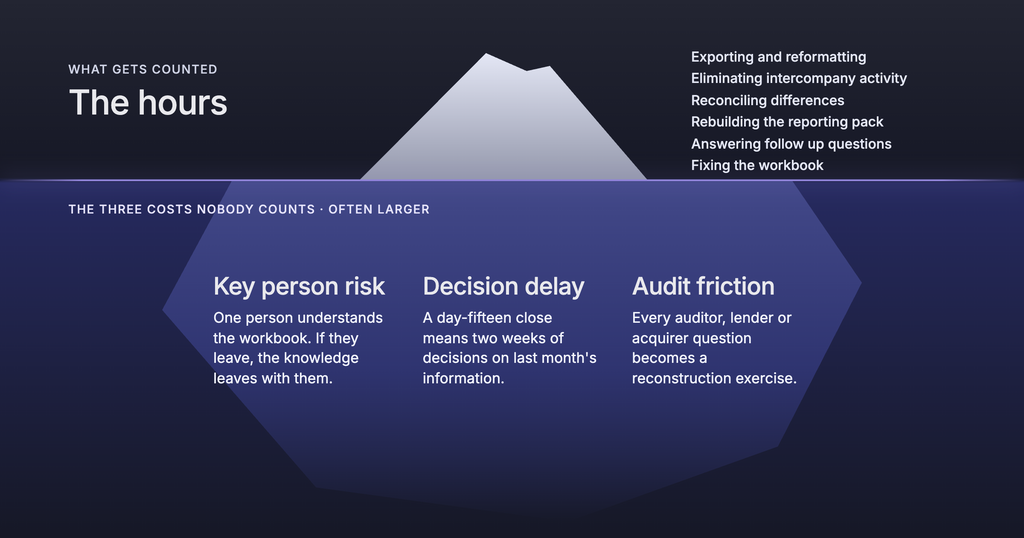
The three costs nobody counts
The hours are the easy part. These are harder to measure and often larger.
Key person risk. In most teams, one person understands the consolidation workbook. Not the process, the workbook. If they leave, the knowledge leaves with them, and rebuilding it takes months. Ask yourself what your close looks like if that person resigns in November.
Decision delay. If the consolidated view is ready on day fifteen, every decision made in the first two weeks of the month was made on last month information. The cost is invisible but real, and it grows with the size of the decisions.
Audit and diligence friction. When the numbers are assembled by hand, every question from an auditor, lender or acquirer turns into a reconstruction exercise. In a transaction, this is where timelines slip and where buyers start discounting for uncertainty.
What changes when the system does the combining
In a system that holds multiple entities together, consolidation is a process you run rather than a document you build. The accounts are shared, intercompany activity can be identified and eliminated by rule rather than by hand, and the result is reproducible. Run it twice and you get the same answer.
The practical difference is not that the close becomes instant. It is that the work shifts from assembling numbers to reviewing them, and that the output can be explained to an auditor without opening a spreadsheet.
And the honest part. Moving systems does not remove close work. Reconciliations still happen, accruals still need judgment, and the first two closes in a new system are usually slower while the team learns it. What goes away is the manual assembly, which is typically the largest and least valuable portion.
Common questions
Our close is only five days, so is this worth it? Possibly not on time alone. Look at the other three costs instead, particularly key person risk. A fast close that depends entirely on one person is still fragile.
Could we fix this with a better spreadsheet? Sometimes, for a while. A well built workbook can absorb two or three entities. The limit is usually not the spreadsheet; it is that nobody else can maintain it.
What about consolidation software on top of our existing files? It is a real option and worth pricing. The trade off is that you add a system rather than remove one, and you still carry the effort of keeping several sets of books aligned.
How do we present this internally? Lead with the hours and the key person risk, not with the software. The question for your leadership is not which product to buy. It is whether the current approach is still appropriate for the size of the business.
Key takeaways
- Manual consolidation is usually the largest unbudgeted cost in a finance department
- Measure it across one real close rather than estimating from memory, and include the people who only help a little
- The hours are the smallest part. Key person risk, decision delay and audit friction are often larger
- A system that holds entities together makes consolidation reproducible, which is what auditors and buyers care about
- Changing systems does not remove close work. It removes the manual assembly.
Need help?
If you want help putting a number on your own close, Reach is happy to walk through the exercise with your team. It takes about an hour and the result is yours either way.