
For decades, ERP platforms have treated quality management as an extension rather than a foundation. That is no longer acceptable.
Ask any quality manager what consumes the most time, and the answer is rarely finding defects. It is documenting them.
Every inspection, deviation, corrective action, and audit requires evidence, traceability, and sign-off. In regulated industries, that burden is not theoretical. It is operational. And for most quality teams, it is relentless.
A single CAPA is not a form. It is a controlled case-management process involving investigation, root-cause analysis, corrective actions, verification, and effectiveness checks. In regulated environments such as pharmaceuticals, medical devices, food manufacturing, and aerospace, completing a CAPA properly can take an experienced quality professional 30 or more hours.
Thirty hours. Per event. For a team that is almost never fully staffed.
That is why audits get caveated. That is why compliance slips. Not because anyone is careless, but because the documentation burden has always outpaced the capacity to handle it. And the systems supporting quality teams were never designed to change that.
Why Quality Implementations Have Always Felt Like a Trap
Most operations and IT leaders have lived through a version of this story:
- A vendor promises a clean, validated quality management system
- The implementation begins
- Every customisation requires documentation
- That documentation is fragile and must be maintained indefinitely
- Two years pass and the system still is not fully stable
- Debugging becomes a permanent job function.
The reason this keeps happening is structural. Quality systems, by design, must be rigid. In regulated industries, you cannot change a workflow and move on. Every change must be documented, validated, and approved. That is not a vendor flaw. That is regulatory reality.
The real problem is that most ERP platforms were never built with this in mind. Quality management was always an add-on module, a bolt-on from a third-party ISV, or a workaround layered on top of a system designed for something else entirely. Over time, that creates fragile architectures, duplicated data, and permanent validation overhead.
The hard stuff was never built in. It was always bolted on. And everyone who has lived through one of these implementations knows exactly what that costs.
What D365 F&SCM Delivers Out of the Box
This is where the conversation changes.
Dynamics 365 Finance and Supply Chain Management ships with a quality management framework embedded directly into supply chain transactions. Not a module purchased separately. Not a third-party integration. Not a configuration workaround. Part of the platform.
Core capabilities include:
- Quality orders triggered automatically by purchasing, production, transfers, or manual events
- Sampling plans and test instruments for structured, repeatable inspections
- Inventory quarantine and disposition controls linked to quality outcomes
- Nonconformance management tied directly to items, batches, vendors, and processes
- Vendor quality tracking integrated with procurement data.
For regulated environments, the platform goes further:
- CAPA case management with workflow-driven corrective and preventive actions
- Root cause analysis enforcement built into the investigation process
- Verification and effectiveness tracking for closed-loop quality control
- Electronic records and electronic signatures supporting FDA 21 CFR Part 11 requirements.
The Part 11 point deserves emphasis. FDA 21 CFR Part 11 governs electronic records and signatures in regulated industries. Compliance is not optional for pharmaceutical, biotech, medical device, or certain food manufacturing companies. Having it built into an ERP platform natively, without a third-party overlay, is rare at the mid-market level.
This does not exist in NetSuite. It does not exist in Business Central. It does not fully exist in Oracle Fusion. D365 F&SCM is one of the first mid-market ERP platforms to offer a genuinely validated quality framework as a native capability. That is not a feature point. That is a strategic buying decision.
All capabilities support FDA expectations, GMP requirements, and 21 CFR Part 11-aligned controls when implemented with appropriate validation and governance.
Where AI Changes the Remaining Bottleneck
Even with quality built natively into the ERP, the investigation and documentation burden still existed. Quality orders could be created, managed, and closed in D365. But someone still had to write the CAPA.
That is where Microsoft Copilot adds genuine value. It does not replace quality professionals. What it does is remove the most time-consuming part of their job: assembling evidence.
Copilot in D365 F&SCM can aggregate traceability data across batches, vendors, and production runs, summaries related quality events and deviations, and draft structured investigation context, all in real time, directly from quality order data.
What used to take 30 hours now takes a fraction of that time. The quality professional reviews, refines, validates, and approves. They stop being documentation administrators and become what they were trained to be: quality professionals.
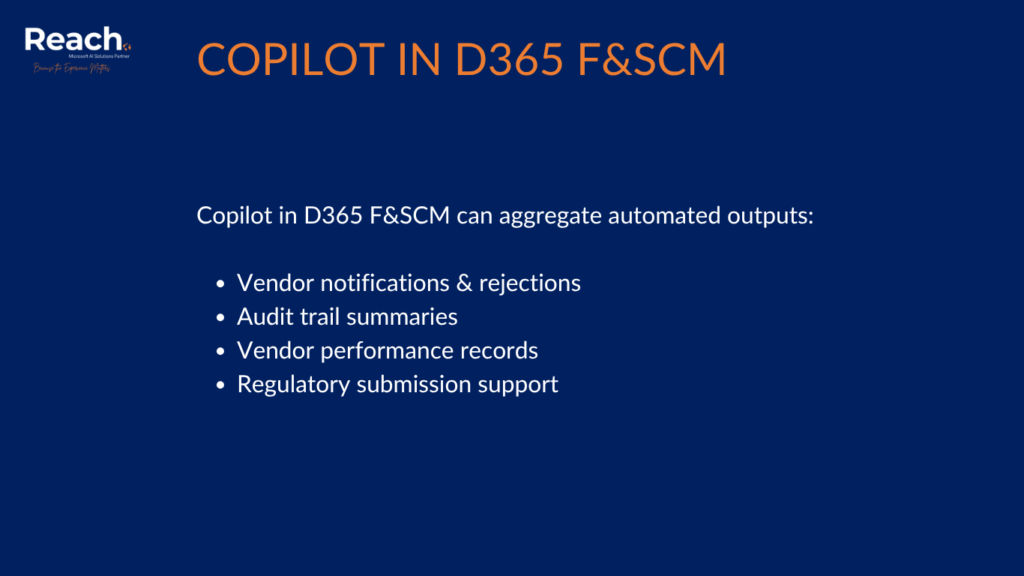
The same capability extends further:
- Vendor notification and rejection letters
- Audit trail summaries
- Vendor performance documentation
- Regulatory submission support.
The reaction from quality and operations leaders who see this demonstrated is almost always the same. Not polite interest. Genuine recognition that a problem they have carried for years finally has a real answer.
As with any regulated system, outcomes depend on disciplined configuration, validated processes, and consistent use.
What This Changes for ERP Buyers
Quality management no longer needs to be a secondary system decision made after the ERP is chosen.
When quality orders, nonconformance handling, CAPA, traceability, audit controls, and AI-assisted documentation are all embedded in the supply chain system itself, the ERP becomes a quality platform, not just a financial ledger.
The questions worth asking now are:
- How many quality events per year are we managing with incomplete documentation?
- How much quality team time is spent on documentation versus actual quality work?
- What would audit readiness look like if CAPA documentation was always complete?
- What is the true long-term cost of maintaining external quality systems in integration and validation overhead?
These are not software questions. They are business questions. And for the first time, a mid-market ERP platform has answers that are built in, not bolted on.
The Bottom Line
Quality management has struggled in ERP for a long time. Not because the need was unclear, but because no platform was willing to do the hard work of embedding it deeply into the transactional core without extensive customization or additional systems.
Quality orders. Nonconformance. CAPA. Audit trails. Traceability. Electronic signatures. AI-assisted documentation.
All built in. Not bolted on.

Ready to move beyond estimates and run Finance & Operations with confidence?
Leverage our Dynamics 365 Finance & Supply Chain Management services to design, implement, and optimize a solution built for real-world delivery.