
When equipment rental companies evaluate ERP modernization options, Microsoft Dynamics 365 consistently emerges as a leading platform candidate.
The Microsoft brand carries weight. The cloud-native architecture aligns with IT strategy. The integration with familiar Microsoft tools like Excel, Outlook, and Teams reduces adoption friction. The global partner ecosystem provides implementation options.
But here’s what many rental executives don’t fully understand when they begin their evaluation: Dynamics 365 is evolving rapidly.
Understanding where the platform stands today, where Microsoft is investing, and how the ecosystem is transforming is essential for making informed technology decisions.
This post provides an honest assessment of the D365 landscape for equipment rental—what’s strong, what’s emerging, and what you need to consider when planning your technology journey.
Where Dynamics 365 Excels Today
Let’s start with the genuine strengths. These are areas where D365 provides world-class capabilities that equipment rental companies should leverage.
Financial Management
D365 Finance delivers enterprise-grade financial management:
- General ledger and financial reporting
- Accounts payable and accounts receivable
- Fixed asset management
- Cash and bank management
- Multi-company and multi-currency support
- Global tax compliance.
The financial foundation is genuinely strong and meets the needs of even sophisticated rental organizations.
For equipment rental specifically, D365 Finance provides:
- Excellent fixed asset tracking for your fleet from a financial perspective
- Robust project accounting for complex rental projects with multiple cost and revenue streams
- Multi-dimensional financial analysis enabling profitability visibility by customer, equipment category, branch, and other dimensions.
Supply Chain Fundamentals
D365 Supply Chain Management handles inventory management, procurement, warehouse operations, and logistics coordination.
For rental companies, this supports:
- Parts inventory for maintenance operations
- Procurement of equipment and supplies
- Warehouse management for parts and accessories.
The supply chain capabilities are designed for traditional buy-sell-distribute scenarios rather than rental specifically, but they provide solid operational foundations.
Field Service Excellence
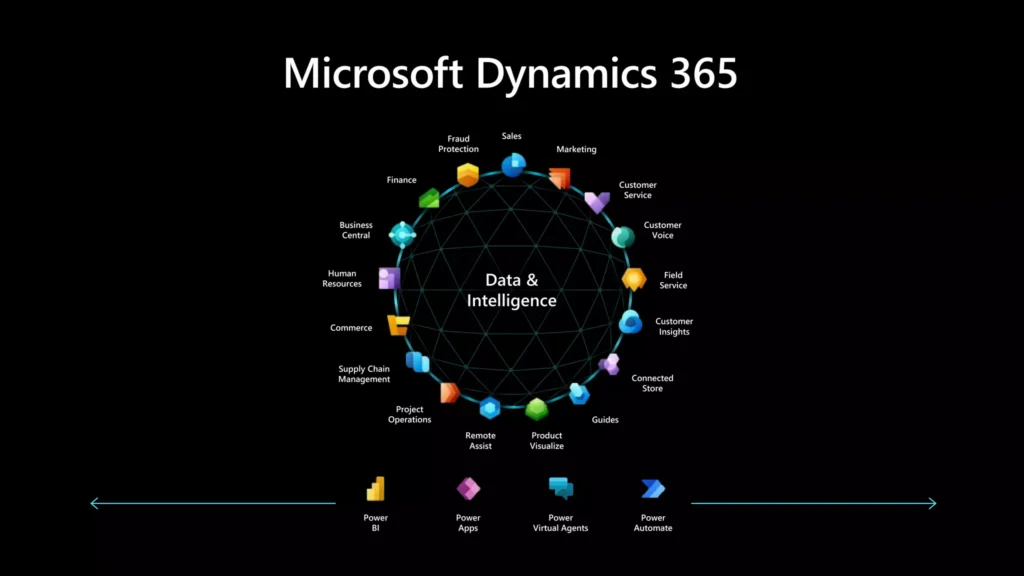
D365 Field Service is genuinely strong for managing service technicians.
Resource Scheduling Optimization uses AI to maximize technician productivity.
The mobile app enables work order management, parts consumption, time capture, and customer signature collection in the field.
Remote Assist integration provides augmented reality support for complex repairs.
For rental companies with service operations, Field Service can significantly improve technician utilization and first-time-fix rates. This is a legitimate platform strength that delivers measurable value.

Customer Relationship Management
D365 Sales and Customer Service provide comprehensive CRM capabilities:
- Opportunity and pipeline management
- Account and contact management
- Customer service case management
- LinkedIn Sales Navigator integration.
The unified customer view across sales and service interactions supports relationship management.
Business Intelligence and Analytics
Embedded Power BI provides sophisticated analytics and visualization without requiring separate BI infrastructure.
Role-based dashboards surface relevant information for different users. The ability to analyze data across the D365 platform—combining financial, operational, and customer data—enables insights that fragmented systems cannot provide.
Copilot AI capabilities are increasingly embedded across D365, providing natural language queries, intelligent suggestions, and automated insights. While still maturing, these capabilities point toward a future of AI-assisted operations.
Integration and Extensibility
The Power Platform—Power Apps, Power Automate, Power BI, and Power Pages—provides low-code tools for extending D365 without custom development.
Azure integration services connect D365 with external systems, IoT devices, and third-party applications. The modern API architecture supports integration scenarios that legacy systems struggle to address.
Where Dynamics 365 Falls Short for Rental Today
Now for the honest assessment.
As of today, D365 does not natively understand the equipment rental business. The platform lacks built-in capabilities for core rental operations that are fundamental to running a rental company.
No Native Rental Availability Management
D365 has no native concept of rental availability.
There’s no out-of-box capability to check whether equipment is available for a specific date range, considering:
- Current rentals
- Scheduled returns
- Maintenance windows
- Existing reservations.
Sales quotes in D365 are designed for product sales, not rental transactions with daily/weekly/monthly rate structures, minimum rental periods, and automatic extensions.
When a rental coordinator needs to quickly quote a customer on equipment availability and pricing, native D365 cannot support that workflow today.
No Rental Contract Management
D365 does not currently include rental contract management.
There’s no native object representing a rental agreement with:
- Start date and expected return date
- Billing frequency and rate structure
- Damage waiver terms
- Equipment specifications
- The dozens of other elements that define a rental transaction.
Sales orders and project contracts exist but don’t map to rental requirements. You cannot manage rental extensions, early returns, equipment swaps, or contract modifications through native D365 capabilities.
Limited Rental Billing Capabilities
Rental billing is fundamentally different from sales invoicing.
Rental requires:
- Periodic billing based on time elapsed
- Handling of partial periods
- Meter-based billing for certain equipment
- Automatic billing for extensions
- Credit processing for early returns
- Damage and fuel billing tied to return inspections.
D365 subscription billing handles some recurring billing scenarios but lacks the flexibility for rental-specific billing logic. Native D365 cannot generate accurate rental invoices without significant enhancement.
No Rental Fleet Operations Tools
D365 Asset Management exists but focuses on maintenance management rather than rental fleet operations.
There are no native capabilities for:
- Tracking rental utilization
- Viewing equipment availability across locations
- Managing rental reservations
- Optimizing fleet allocation.
The operational dashboards and workflows that rental coordinators need to manage their daily work—availability boards, reservation management, rental status tracking, off-rent processing—simply don’t exist in native D365 today.
Microsoft’s Strategic Investment: The Game-Changer
Here’s where the landscape gets interesting.
Microsoft has recognized these gaps and made a significant strategic commitment to address them.
The December 2025 Announcement
In December 2025, Georg Glantschnig, Corporate Vice President for AI ERP at Microsoft, announced substantial investment in rental management capabilities for Dynamics 365.
This wasn’t a vague roadmap mention. It was a concrete commitment with specific capabilities and timeline.
What Microsoft Is Building
The announced capabilities, planned for release in Q4 2026, include:
Quoting and Reservations Confirm availability and seamlessly convert opportunities into contracts. This addresses the fundamental gap of rental availability management and quote generation.
Contract and Pricing Management Support for short and long-term rentals, rent-to-own programs, and seasonal pricing with flexible terms and rate structures. This brings native rental contract capabilities to the platform.
Inspections Orchestration Coordinate inspections upon deliveries, transfers, and returns. This addresses the critical equipment handoff points in the rental lifecycle.
Billing and Invoicing Tied directly to rental activity to improve accuracy and reduce reconciliation effort. This tackles the rental billing complexity that current systems can’t handle.
Why This Matters
Microsoft’s announcement reflects recognition that rental and asset-as-a-service business models are becoming central to how organizations create value across industries.
As Glantschnig noted, this extends far beyond traditional equipment rental into:
- Medical devices
- Technology assets
- Renewable energy
- Any sector where customers want access without ownership.
The investment signals Microsoft’s commitment to making D365 a comprehensive platform for rental operations—not just a financial and supply chain system that requires extensive customization.
The ISV Integration Strategy
Perhaps most significantly, Microsoft explicitly stated they are building these foundational capabilities to enable the partner and ISV ecosystem to deliver specialized, deeply vertical solutions.
The announcement emphasized that “because these foundational capabilities will run natively in Microsoft Dynamics 365 on the Microsoft Cloud, customers, ISVs, and partners can extend them with AI agents using MCP and Microsoft Copilot Studio.”
This signals a collaborative approach:
- Microsoft provides the rental foundations
- Partners and ISVs deliver industry-specific depth
- Combined solutions are more powerful than either alone.
Equipment rental ISVs who have built specialized solutions over years can integrate their deep domain expertise with Microsoft’s native platform capabilities.
The Agentic ERP Vision
Microsoft’s rental investment is part of a broader vision for “agentic ERP”—systems that move beyond recording transactions to actively orchestrating processes, anticipating needs, and adapting to change.
The integration of AI and Copilot capabilities with rental operations suggests a future where systems:
- Proactively identify utilization opportunities
- Flag potential issues before they become problems
- Automate routine decisions
- Provide intelligent recommendations.
This positions D365 not just as a system of record but as what Microsoft calls “a system of action” that aligns people, data, and workflows around business outcomes.

What This Means for Equipment Rental Companies
Microsoft’s announcement has significant implications for organizations evaluating or planning technology investments.
Validation of the Platform Direction
For organizations considering D365, Microsoft’s investment validates the platform as the right long-term foundation for rental operations.
The strategic commitment reduces the risk that rental will remain a gap requiring indefinite workarounds.
Timeline Considerations
The Q4 2026 timeline means native capabilities are roughly 18 to 24 months away.
Organizations facing urgent operational challenges or competitive pressure may not be able to wait. Those with longer planning horizons can factor native capabilities into their roadmap.
The Transition Path
Organizations implementing D365 today with ISV rental solutions will have a clear path to adopt native capabilities as they mature.
The integration approach Microsoft outlined—with ISVs building on native foundations—suggests that existing ISV implementations won’t become obsolete. Rather, they will evolve to leverage native capabilities while continuing to provide specialized depth.
Implementation Partner Selection
Choosing implementation partners who understand both the current state and the evolving roadmap becomes critical.
Partners should be able to:
- Deliver value today with available solutions
- Position implementations to benefit from native capabilities as they arrive
- Navigate the transition thoughtfully.
Look for evidence of successful rental implementations and references from organizations similar to yours.
The Architecture: Today and Tomorrow
Here’s the realistic view of how equipment rental technology on D365 is evolving.
Today’s Architecture
| Component | What It Provides |
| D365 Finance | Financial management, fixed assets, project accounting, reporting |
| D365 Supply Chain Management | Parts inventory, procurement, warehouse operations |
| D365 Field Service | Technician management, work orders, field operations |
| D365 Sales & Customer Service | CRM capabilities |
| Power Platform | Custom apps, workflow automation, analytics, portals |
| ISV Rental Solutions | Rental quoting, contracts, billing, availability, fleet operations, inspections |
Tomorrow’s Architecture (Post Q4 2026)
| Component | What It Provides |
| Native D365 Rental Capabilities | Foundational quoting, reservations, contract management, inspections, billing |
| ISV Solutions | Industry-specific depth, specialized workflows, vertical functionality built on native foundations |
| AI and Copilot | Intelligent automation, insights, decision support |
| Unified Platform | Seamless integration across all rental operations |
The evolution is from “platform plus ISV” to “enhanced platform with ISV specialization”—a maturation that benefits customers through tighter integration and reduced complexity.
Evaluating the D365 Path: Key Questions
For equipment rental companies considering D365, the evaluation should address several dimensions.
Platform Fit
Does D365’s overall architecture align with your technology strategy?
Consider:
- Cloud deployment model
- Microsoft ecosystem integration
- Global capabilities for multi-country operations
- Long-term platform direction.
Microsoft’s rental investment strengthens the case for organizations who want a unified Microsoft foundation.
Timing and Urgency
What’s your timeline for transformation?
If you need to move quickly, evaluate current ISV solutions that can deliver value immediately. If you have a longer horizon, factor in how native capabilities might influence your approach.
Implementation Partner Capability
Does your implementation partner understand both the current ISV landscape and Microsoft’s evolving roadmap?
Can they deliver value today while positioning your implementation for future native capabilities?
Partners with deep rental industry experience and strong Microsoft relationships are best positioned to navigate this evolution. Look for evidence of successful rental implementations and references from organizations similar to yours.
Total Cost Considerations
What’s the realistic total cost including:
- Platform licensing
- Current ISV requirements
- Implementation services
- Change management
- Ongoing support.
How might costs evolve as native capabilities reduce ISV dependencies for foundational functionality? Build scenarios that account for the evolving landscape.

Future Flexibility
How will your solution evolve as Microsoft delivers native rental capabilities?
Ensure your implementation approach and partner relationships provide flexibility to adopt native features while retaining specialized ISV capabilities where they provide superior functionality.
The Bottom Line
Microsoft Dynamics 365 is transforming from an excellent foundation that requires ISV augmentation for rental into a comprehensive platform with native rental capabilities enhanced by specialized ISV solutions.
For equipment rental companies, this evolution is unambiguously positive.
It validates the platform choice. It reduces long-term complexity. It positions organizations for AI-enabled operations that weren’t previously possible.
The key is understanding:
- Where the platform stands today
- Where it’s heading
- How to make implementation decisions that deliver value now while positioning for the future.
Organizations that navigate this transition thoughtfully will emerge with more powerful, more integrated, and more intelligent rental operations than ever before possible.
Whether your organization is early in exploring options or actively planning a transformation, understanding this evolving landscape is essential for making decisions you won’t regret in three to five years.
The equipment rental industry’s technology foundation is shifting. The organizations that understand the shift will be best positioned to benefit from it.