
Introduction: what time does that get written down?
A customer calls to say the machine is ready for pickup. What time does that get written down?
If the honest answer is “when someone gets to it”, you have found a rental revenue leak. The money is lost in the gap between a customer saying they are done and a timestamp in the system. In rental, the invoice is built from time. When a real event and its record in the system are hours or days apart, money moves. Sometimes away from you, sometimes into a dispute.
Most rental leaks are not fraud or big mistakes. They live in handoffs: the moments when a job passes from one person or one system to the next.
The problem: three kinds of lost time
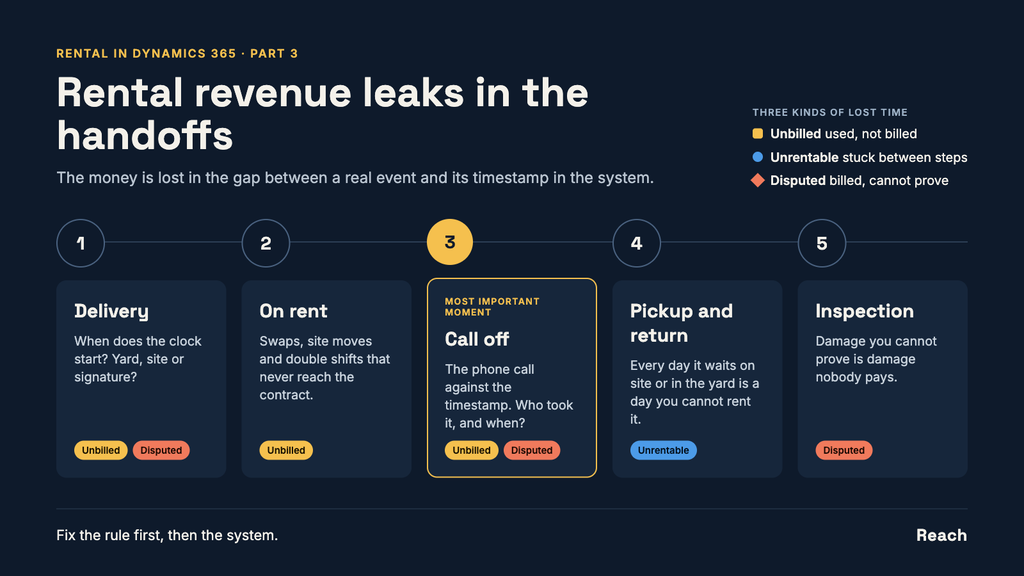
It helps to give the leaks names. There are three kinds:
- Unbilled time. The customer used the machine, but you did not bill it. For example, extra hours above the daily limit that never reached the invoice
- Unrentable time. Nobody pays, because the machine is stuck between steps. For example, it is off rent, but it waits on the job site for a truck
- Disputed time. You billed it, but the customer does not agree and you cannot prove it. For example, the customer says they called on Tuesday, and your system says Friday.
These three kinds show up in five handoffs.
1. Delivery: when does the clock start? Is it when the machine leaves the yard, when it arrives on site, or when the customer signs? If the contract says one thing and the system does another, you lose time or start a dispute on the first invoice.
2. On rent: the changes nobody writes down. A machine is swapped for another one. It moves from one site to another. It works a double shift. Each change should reach the contract. Often it stays in a driver’s head or a phone message.
3. The call off: the phone call against the timestamp. The customer says they are done. This is the call off, also called off hire. For billing, this is the most important moment of the rental. And it often arrives by phone, email or a word to the driver. If the record is late, you bill too long and send a credit note later. If billing stops too early, for example at the call when your contract says it stops at pickup, you lose rent. Either way, the customer remembers.
4. Pickup and return: the machine nobody pays for. After the call off, the machine is still yours to collect. Every day it waits on site, or waits in the yard for inspection, is a day you cannot rent it.
5. Inspection: damage you cannot prove is damage nobody pays. If the condition is not recorded when the machine goes out and when it comes back, you cannot show who caused the damage. A photo, a meter reading and a signature at both ends make the difference between a recovery and a write off.
One more thing: a leak goes both ways. Billing too long is not extra money. It comes back as a credit note, a late payment and an unhappy customer.
The solution: fix the rule first, then the system
Software helps, but only after the rules are clear. Six rules close most of these gaps:
- Write the stop rule into the contract. Billing stops at the call off, at pickup, or when the machine is back in the yard. Pick one, and make it clear to the customer
- Record who and when, not only what. Every call off should carry the time it came in, the person who took it, and how it came (phone, email, portal)
- Record changes on the day they happen. Swaps, site moves and extra hours go to the contract the same day, not at month end
- Read the meter at every handover. Out, transfer and return. Meter hours are revenue and maintenance at the same time
- Inspect at both ends in the same way. Same checklist, photos and signature at delivery and at return
- Measure the gaps. Time from call off to pickup, and from return until the machine is ready to rent again. If nobody measures these gaps, nobody owns them.
A simple example shows why the gaps matter. Example only: a branch has 40 machines a week that wait one extra day for pickup. That is 40 days a week those machines are not available to rent. Over a year, that is about 2,000 days. It is like having five or six machines stand in the yard all year.
What to check in Dynamics 365
If you run Dynamics 365, or plan to, use the six rules as a test for any rental solution. Can it record the time of a call off and the person who took it? Can a meter reading at handover reach the contract and the service plan? Can inspection photos and signatures stay with the machine? Ask to see each of these in a demo, with your own contract rules.
Results: what changes when the handoffs are tight
- Fewer credit notes and fewer disputes, because every stop has a time and a name
- More rentable days from the same fleet, because machines come back and get ready faster
- Damage costs go to the party that caused them
- Finance can trust the invoice run, instead of checking it by hand.
Call to action: map your handoffs
Start with one question for your team: when a customer calls off a machine, what time does the system show, and who entered it? If the answer is not clear, Reach can help you map your handoffs and set the rules.
This is the third of four articles on rental in Dynamics 365. Previous: Rental is not an inventory problem. Next: Native rental or a rental add-on.

Stop rebuilding your rental rules by hand.
Reach can help you get your fleet ready for rental in Dynamics 365 governed, tested, and production ready before the release.
A time leak happens when the real event, like a customer calling off a machine, and the moment that gets recorded in your system, are not the same. The gap between them is where money gets lost or disputed.
Unbilled time, unrentable time, and disputed time. Unbilled means the customer used the machine but it never made it to the invoice. Unrentable means the machine sits idle between steps, so nobody pays for it. Disputed means you billed it, but the customer disagrees and you have no record to back it up.
At the five handoffs: delivery, on rent changes, call off, pickup and return, and inspection. Each one is a moment where information has to move from one person or system to another, and that is where details get lost.
It is usually the most important moment for billing. If the time is recorded late, you overbill and have to send a credit note. If it is recorded too early, you lose rent you were owed. Either way, the customer notices.
Write a clear stop rule into the contract. Record who took the call and when. Log changes like swaps or site moves the same day they happen. Read the meter at every handover. Inspect equipment the same way at both ends. Measure the time gaps so someone is accountable for them.

Alek is a Senior Dynamics 365 F&O Consultant at Reach, helping businesses get more value from their ERP systems. His work spans three core areas: Manufacturing, Master Planning (MRP), and Asset Management. He brings experience from multiple rollouts and implementations across automotive, mining and drilling, and high tech industries.