
Introduction
Every ERP claims to support multi-currency operations. It’s a checkbox on every feature comparison. But there’s a massive gap between “you can enter a transaction in a foreign currency” and “the system handles the currency complexity of a global investment manager.”
When you operate in six countries, have 45 bank accounts across nine currencies, and need to produce consolidated financials in multiple reporting currencies, you quickly discover whether your ERP really supports multi-currency or just has the feature on paper.
What the Data Says: The Global Volatility Tax
Recent data from McKinsey and Gartner suggests that for global firms, currency isn’t just an accounting detail—it’s a primary driver of operational risk.
- The Volatility Reality: In its 2025 Global Financial Stability Report, the IMF (and echoed in Gartner’s 2025 CFO priorities) noted that FX volatility has intensified due to shifting trade policies and geopolitical distance. For investment managers, this “volatility tax” can erode margins by up to 5–10% if not managed with real-time system visibility.
- Automation and Strategy: A 2024 McKinsey survey found that high-performing finance functions—those that have moved away from manual FX spreadsheets—spend 60% more time on strategic analysis.
- The “Money in Motion” Challenge: McKinsey’s Asset Management 2025 report reveals that global AUM has reached a record $147 trillion, but profitability margins are tightening. Managers are being forced to find “precision strategies” to handle cross-border flows without increasing headcount.

Understanding the Layers of Currency
Investment managers deal with currency at multiple levels, each with different requirements:
Transaction Currency: The currency in which an actual payment or receipt occurs. When you pay a UK vendor in GBP, that’s the transaction currency.
Functional Currency: The primary currency of each legal entity’s economic environment. Your UK subsidiary probably has GBP as its functional currency, even if it occasionally transacts in EUR or USD.
Reporting Currency: The currency (or currencies) in which you prepare financial statements. A US-parented investment manager likely needs USD consolidated financials, but might also need GBP or EUR versions for certain stakeholders.
Accounting Currency vs. Reporting Currency: D365 Finance distinguishes between accounting currency (the currency of the ledger for a legal entity, equivalent to functional currency) and reporting currency (a secondary currency tracked in parallel). This dual-currency ledger capability eliminates the need to run separate ledgers or maintain shadow accounting systems.
Generic ERPs often blur these distinctions. They let you enter foreign currency transactions and convert them, but they don’t handle the full complexity of legal entities with different functional currencies, proper currency translation for consolidation, or parallel reporting in multiple currencies.
Revaluation: Where It Gets Real
Unrealized foreign currency gains and losses are a fact of life for global investment managers. When you have GBP receivables on your USD books and exchange rates move, those receivables change in USD value. Accounting standards require recognition of these unrealized gains and losses.
D365 Finance handles revaluation properly:
Selective Revaluation: Choose which accounts to revalue. You might want to revalue customer receivables but leave intercompany balances at historical rates (since they’ll eliminate in consolidation anyway).
Proper Gain/Loss Recognition: Revaluation entries post to unrealized gain/loss accounts in the P&L, separate from realized gains and losses on actual settlements.
Multiple Revaluation Options: Run revaluation on different schedules for different account types. Revalue cash daily, receivables monthly, depending on your needs.
Automatic Reversal: Unrealized revaluation entries can automatically reverse at period start, ensuring that when transactions actually settle, the system calculates realized gains and losses correctly.
Reporting Dimensions: Revaluation gains and losses post with appropriate financial dimensions, so you can analyze currency impact by boutique, cost center, or other dimensions.
Compare this to generic ERPs where revaluation is often a manual calculation, a spreadsheet exercise, or handled outside the system entirely.
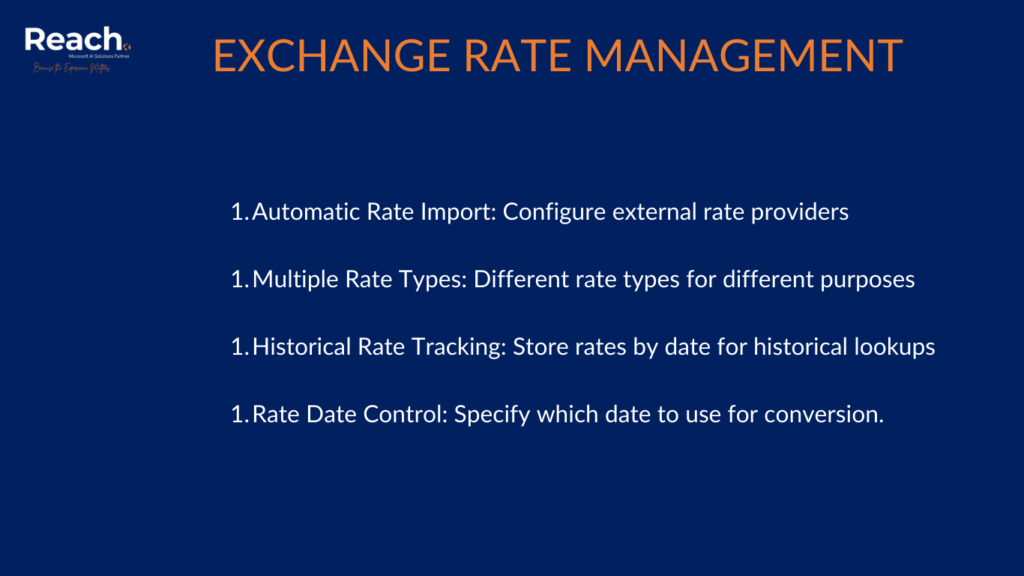
Exchange Rate Management
Accurate revaluation and translation depend on accurate exchange rates. D365 Finance provides:
Automatic Rate Import: Configure external rate providers (central banks, commercial services) and import rates automatically on a schedule. No manual rate entry.
Multiple Rate Types: Different rate types for different purposes. Spot rates for transactions, average rates for income statement translation, closing rates for balance sheet translation.
Historical Rate Tracking: Store rates by date for historical lookups. Important for transactions that need to be valued at historical rates (certain equity transactions, historical cost items).
Rate Date Control: Specify which date to use for conversion. Transaction date, posting date, a specified date. Different transactions may need different date logic.
Currency Translation for Consolidation
When consolidating foreign subsidiaries, currency translation is required. A UK subsidiary with GBP functional currency needs to translate to USD for inclusion in USD consolidated financials.
D365 Finance handles this as part of the consolidation process:
- Balance Sheet Translation: Balance sheet accounts translate at the closing rate (period-end exchange rate)
- Income Statement Translation: Revenue and expense accounts translate at the average rate for the period
- Equity Translation: Contributed capital and certain equity items translate at historical rates
- Translation Adjustment: The difference between translating at different rates flows to a currency translation adjustment account in equity (cumulative translation adjustment, or CTA).
This happens automatically during consolidation. No manual calculation. No spreadsheet. Proper accounting treatment built into the system.
Parallel Reporting with Dual-Currency Ledger
Some investment managers need to maintain parallel accounting in multiple currencies. Perhaps you have US investors who need USD financials and European investors who need EUR financials, and you need both to be “primary” records, not translations.
D365 Finance supports this through the dual-currency ledger:
- Accounting Currency + Reporting Currency: Each legal entity has an accounting currency and can optionally have a reporting currency. Transactions post to both simultaneously
- Different Rate Dates: The reporting currency can use different exchange rate dates than the accounting currency posting
- True Parallel Ledger: The reporting currency isn’t just a translation view. It’s a full second ledger with its own trial balance.
This eliminates scenarios where firms run duplicate entries in different company instances or maintain parallel records in spreadsheets.
Cash Positioning Across Currencies
Investment managers often hold significant cash balances in multiple currencies. Daily cash positioning requires understanding your cash picture across all currencies, both in local terms and converted to a common view.
D365 Finance cash management provides:
- Multi-Currency Cash Overview: See cash positions across all accounts in local currency and converted to any reporting currency
- Projected Cash Flow: Cash flow forecasting that considers currency of expected receipts and payments
- Automatic Posting by Currency: Different posting profiles by currency for proper segregation of currency-specific activity.
Practical Implications
Currency handling affects almost every finance process:
- Accounts Payable: Entering invoices in vendor currency, managing foreign currency payment runs, handling FX gain/loss on payment
- Accounts Receivable: Billing in customer currency, applying receipts in original or different currencies, managing revaluation of outstanding balances
- Banking: Reconciling accounts in multiple currencies, proper currency handling for bank transfers, cash pooling across currencies
- Fixed Assets: Assets acquired in foreign currency, proper currency handling for depreciation and revaluation
- Projects: Project costs in multiple currencies, proper currency translation for project profitability reporting.
If currency is an afterthought in your ERP, each of these areas creates friction and workaround requirements.
Migration Considerations
Moving to a system with better currency capabilities requires planning:
- Historical Rates: Migrate historical exchange rate data for proper lookups.
- Opening Balances by Currency: Opening balances need to reflect original currency amounts and historical USD equivalents.
- Unrealized Gain/Loss Positions: Consider whether to migrate cumulative unrealized gain/loss positions or reset as of migration date.
- Rate Provider Setup: Establish automatic rate import before go-live.
Conclusion
Currency complexity is fundamental to investment management operations. Generic ERPs that treat multi-currency as a secondary feature create endless workarounds and reconciliation challenges.
D365 Finance provides the currency infrastructure that investment managers need: proper revaluation, translation for consolidation, dual-currency ledger capability, and automatic rate management.
Ready to Modernize Your Finance Operations?
Don’t let legacy systems and manual spreadsheets hold back your firm’s growth. Whether you are managing 10 entities or 100, our Finance and Supply Chain Management services are designed to help investment managers unlock the full potential of Microsoft Dynamics 365.
How We Can Help:
- Custom Implementation: Transition from manual processes to an automated, multi-entity environment tailored to PE and investment boutique needs.
- Consolidation Strategy: Design a “single source of truth” for real-time reporting across all fund families and jurisdictions.
- Managed Services: Ongoing support to ensure your system evolves alongside changing regulatory requirements and new fund launches.
Next in this series: Blog 4: Regulatory Compliance in Investment Management.