
To architect a future-proof Dynamics 365 Finance & Supply Chain Management (D365 F&SCM) environment, architects must shift from “Interface-Centric” to “Context-Centric” design. By applying Model Context Protocol (MCP) principles, organizations can transform their ERP from a static system of record into an AI-ready ecosystem where data isn’t just synchronized, but understood by both human and AI agents.
This architectural shift ensures that as AI evolves from a passive observer to an active participant in supply chains and financial audits, it operates within governed “context contracts.” This prevents the common pitfall of AI “hallucinating” over raw data tables by providing a semantic layer that defines ownership, business logic, and authoritative sources across global legal entities.
Ultimately, the goal is to build an Intelligent Enterprise whered365 f&scm acts as the core engine. By treating data as a product and integrations as explicit contracts, architects reduce material business risk and create a resilient foundation that can absorb rapid regulatory and technological changes without requiring a total system overhaul.
ERP Failure and Material Risk
For D365 F&SCM architects, the risk of traditional implementation remains high, and AI adds a new layer of complexity.
- Failure Rates: Gartner predicts that through 2027, over 70% of ERP initiatives will fail to fully meet their original business case goals.
- Complexity Multiplier: Organizations frequently underestimate implementation complexity by 300% to 500% when dealing with legacy integrations and governance.
- The Trough of Disillusionment: Supply Chain Generative AI has officially entered the “trough of disillusionment” in 2025, as pilots struggle to move into production due to data quality and governance concerns.

The Architect’s Lens on ERP Decisions
In large and complex organizations, ERP decisions are rarely made on feature checklists alone. Solution architects are tasked with evaluating platforms based on longevity, extensibility, integration patterns, and risk. Increasingly, that evaluation must also account for AI participation in core business processes.
Building on the ideas introduced in The Future of MCP Integrations and MCP, AI, and the Future of Dynamics 365 Business Central, this article examines how those same MCP principles apply, at scale, to Dynamics 365 Finance & Supply Chain Management (F&SCM).
Why MCP Thinking Matters More in F&SCM
Dynamics 365 F&SCM environments are fundamentally different from SMB ERP deployments:
- Multiple legal entities and operating models
- Complex supply chains and financial controls
- High transaction volumes and regulatory scrutiny
- Extensive integrations with external platforms.
In this context, integration failures are not inconveniences—they are material business risks. MCP-style integration thinking provides a framework for managing that complexity as AI becomes embedded into enterprise operations.
From Integration Architecture to Context Architecture
The Current Reality
Most F&SCM implementations rely on a combination of:
- Dual-write or near-real-time synchronization
- Azure-based integration services
- iPaaS platforms and custom middleware
- Batch and event-driven processing.
While technically sound, many architectures remain interface-centric rather than context-centric.
The MCP Shift
MCP reframes integration around shared understanding:
- What business concept does this data represent?
- Who owns it, and who is allowed to act on it?
- What downstream processes depend on it?
- What level of confidence and quality is required?
For solution architects, this shift enables designs that are resilient to change rather than tightly coupled to today’s requirements.
AI Changes the Role of F&SCM
AI as an Actor in Enterprise Processes
In F&SCM, AI will increasingly:
- Monitor financial and operational signals continuously
- Recommend corrective actions (not just insights)
- Execute predefined actions within governance boundaries.
This elevates the importance of context contracts—AI cannot safely operate on raw data alone.
Implications for Architects
Architects must assume that:
- AI agents will read from and write to enterprise systems
- Not all actions will be human-initiated
- Auditability and explainability are mandatory.
MCP principles help formalize these assumptions into architecture decisions.
Data Domains, Not Tables
One of the most common failure points in large F&SCM programs is treating data structures as implementation details rather than enterprise assets.
MCP-aligned architectures emphasize:
- Canonical business domains (Finance, Supply Chain, Procurement, Manufacturing)
- Explicit ownership of master and reference data
- Consistent semantics across legal entities and regions.
This approach dramatically reduces friction when layering AI, analytics, or cross-platform automation on top of F&SCM.
Dual-Write and Beyond: A Context Perspective
Dual-write patterns are often evaluated purely on synchronization mechanics. From an MCP perspective, the more important questions are:
- Which system is authoritative for which business concept?
- What is the tolerance for latency and inconsistency?
- How are conflicts detected, explained, and resolved?
Architects who answer these questions upfront create space for AI-driven processes without destabilizing core financial operations.
Governance Is the Enabler, Not the Constraint
Large organizations often view governance as an obstacle to innovation. In an AI-enabled F&SCM environment, governance becomes the enabler:
- Policies define what AI is allowed to do
- Controls define when humans must intervene
- Monitoring ensures continuous compliance.
MCP-style integration architectures embed governance into execution rather than bolting it on after the fact.
A Reference Architecture Mindset
Rather than prescribing a single technical stack, MCP encourages a mindset:
- Event-driven where possible
- Asynchronous by default
- Explicit contracts between systems
- Observability across business outcomes, not just interfaces.
This mindset aligns well with cloud-native F&SCM deployments and provides a durable foundation for future AI capabilities.
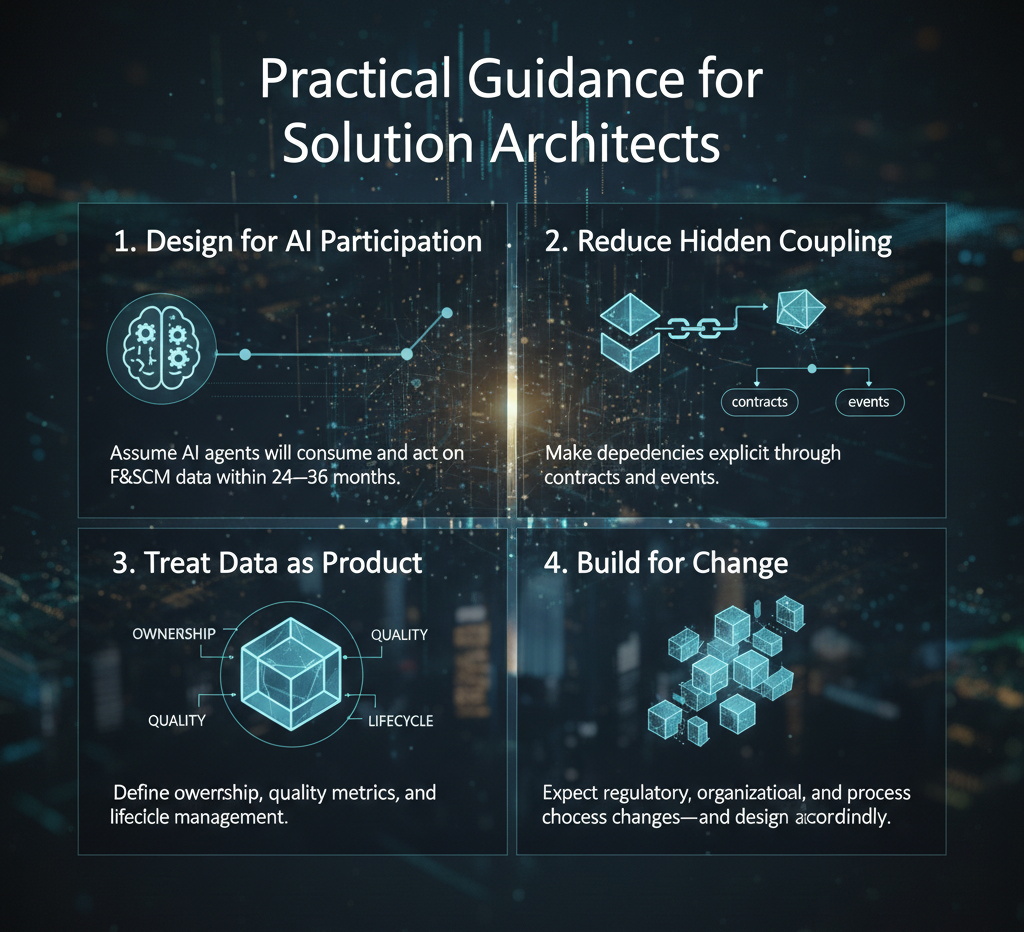
Practical Guidance for Solution Architects
1. Design for AI Participation
Assume AI agents will consume and act on F&SCM data within 24–36 months.
2. Reduce Hidden Coupling
Make dependencies explicit through contracts and events.
3. Treat Data as Product
Define ownership, quality metrics, and lifecycle management.
4. Build for Change
Expect regulatory, organizational, and process changes—and design accordingly.
Looking Forward
Dynamics 365 F&SCM is well-positioned to serve as a core enterprise platform in an AI-driven operating model. However, success depends less on out-of-the-box features and more on architectural discipline.
Solution architects who adopt MCP principles—explicit context, governed integration, and AI-aware design—will be better equipped to guide their organizations through the next decade of ERP evolution.
Final Thoughts
ERP architecture is no longer just about stability and scale. It is about intelligent coordination across systems, data, and agents. MCP provides a practical lens for solution architects designing the future of Dynamics 365 Finance & Supply Chain Management—one where AI enhances, rather than destabilizes, the enterprise.
Why Reach is the Choice for the Next Decade
In today’s rapidly shifting landscape, Reach is at the forefront of the next generation of enterprise software by offering ERP solutions built on Model Context Protocol (MCP) principles. Unlike legacy systems that simply act as static databases, Reach provides a dynamic integration layer that allows your business data to be fully “AI-ready” from day one.

Principal at Reach
Radovan Miodragovic is a Dynamics 365 Technical Solution Architect and Team Lead in Reach with over 17 years of experience in delivering complex technical solutions. A solution-oriented leader, he specializes in the architectural design, development, and implementation of Microsoft Dynamics 365 for Finance and Operations, alongside expertise in Azure, Power Platform, and DevOps. Radovan holds a Master of Science in Electronics Engineering and carries an extensive list of industry credentials, including the Dynamics 365: Finance and Operations Apps Solution Architect Expert certification.
Model Context Protocol (MCP) is a framework for ensuring that AI models have the correct context, permissions, and metadata when interacting with enterprise data, moving beyond simple API calls to “context-aware” interactions.
It encourages moving logic out of “hidden” X++ customizations and into explicit, contract-based services that can be audited and utilized by AI agents.
No. It requires layering a “Context Contract” over Dual-Write so the system knows why data is moving, not just that it is moving.
While designed for complex organizations with multiple legal entities, the principle of “Data as a Product” benefits any business looking to implement AI safely.