
Introduction
You’ve made the decision: D365 Finance is the right platform for your investment management firm. Now comes the hard part: actually implementing it.
ERP implementations have a reputation for going over budget, over timeline, and under-delivering on promised benefits. But they don’t have to. With the right approach, realistic expectations, and proper resources, D365 Finance implementations for investment managers can deliver on their promise.
Here’s a practical roadmap based on real implementations.
Phase 1: Foundation (Months 1-2)
Project Setup and Governance
Before touching the software, establish the foundation for success:
- Executive sponsorship: Identify a C-level sponsor (typically CFO) who will champion the project, remove obstacles, and make decisions when needed
- Steering committee: Establish governance with representatives from Finance, IT, Operations, and key boutiques
- Project team: Dedicate resources. A 35-entity implementation typically needs 2-3 full-time internal resources plus implementation partner team
- Decision-making framework: Define how decisions get made, who has authority, and how conflicts resolve.
Requirements Validation
You documented requirements during vendor selection. Now validate and detail them:
- Process workshops: Walk through current processes end-to-end with people who actually do the work
- Gap analysis: Compare current state to D365 Finance standard functionality
- Fit/gap decisions: For each gap, decide: accept standard, configure differently, extend with Power Platform, or accept limitation
- Integration inventory: Document all systems that need to connect to D365 Finance.
Environment Setup
- Provision development and test environments
- Establish DevOps practices and deployment pipelines
- Configure security baseline
- Set up project documentation repository.
Phase 2: Design and Configure (Months 3-5)
Core Configuration
D365 Finance configuration follows a logical sequence:
- Organization structure: Legal entities, operating units, organizational hierarchies
- Ledger setup: Chart of accounts, financial dimensions, fiscal calendars, currencies
- Subledger configuration: AR, AP, Fixed Assets, Cash Management, Project Accounting
- Workflow design: Approval workflows for journals, invoices, expenses
- Security: Roles, duties, privileges mapped to your organization.
Investment Management-Specific Design
Pay particular attention to:
- Financial dimensions: Design dimensions for boutique, fund family, strategy, and other investment management constructs
- Intercompany relationships: Configure automatic posting rules for intercompany transactions
- Consolidation structure: Define consolidation companies, elimination rules, currency translation methods
- Reporting requirements: Map current reports to D365 Finance capabilities, identify gaps requiring Power BI.
Integration Design
Investment managers typically integrate D365 Finance with:
- Banking platforms for payments and bank feeds
- Investment accounting or portfolio management systems
- HCM/payroll systems (Workday, ADP, Ceridian)
- Expense management (Concur, if not using D365 Expense)
- Tax engines (Vertex, Avalara).
Design integration patterns, error handling, and reconciliation processes.

Phase 3: Build and Test (Months 6-9)
Configuration Build
Execute the design in the development environment:
- Complete all configuration workbooks
- Build custom reports and analytics
- Develop Power Platform extensions
- Configure integrations.
Data Migration
Data migration is often underestimated. Plan for:
- Master data: Chart of accounts, customers, vendors, employees, fixed assets
- Open transactions: Open AP invoices, open AR invoices, open POs
- Historical data: Determine how much history to migrate (typically 2-3 years for trend analysis)
- Opening balances: Trial balance as of go-live date.
Run multiple mock migrations. Each iteration improves quality and reduces cutover risk.
Testing
Testing happens in waves:
- Unit testing: Individual functions work as configured
- Integration testing: End-to-end processes work across modules
- User acceptance testing (UAT): Business users validate the system meets requirements
- Performance testing: System handles expected transaction volumes
- Security testing: Access controls work as designed.
For investment managers, ensure testing covers:
- Month-end close process end-to-end
- Consolidation across all entities
- Intercompany transactions and eliminations
- Multi-currency transactions and revaluation
- Key financial reports match expected results.
Phase 4: Deploy (Months 10-12)
Training
Training should be role-based and hands-on:
- Finance users: Transaction entry, approvals, inquiries
- Controllers: Close processes, consolidation, reporting
- Approvers: Workflow actions, delegation
- IT/Admin: Security administration, troubleshooting.
Don’t underestimate training time. Budget for 40+ hours per heavy user.
Cutover Planning
Cutover for a complex investment manager typically spans a long weekend:
- Friday: Final data extract from legacy system
- Saturday: Data load and validation
- Sunday: Final reconciliation, go/no-go decision
- Monday: Go-live.
Have a rollback plan. Define criteria that would trigger rollback.
Hypercare
Plan for 4-6 weeks of intensive support post-go-live:
- Extended implementation team availability
- Daily issue triage meetings
- Fast-track fixes for critical issues
- User support beyond normal help desk.
Critical Success Factors
Executive Engagement
Projects with actively engaged executive sponsors succeed at much higher rates than projects where executives delegate and disappear. The CFO should be visible, attend key meetings, and intervene when obstacles arise.
Dedicated Internal Resources
Firms that assign dedicated, full-time internal resources to the project consistently outperform firms that ask people to handle implementation “on top of” their normal jobs. The people who know your business must be available to make decisions, validate configuration, and test thoroughly.
Change Management
Technical implementation isn’t enough. People need to change how they work. Invest in:
- Communication about why the change is happening
- Training that builds confidence
- Support during the transition period
- Recognition of people who embrace the new system.
Implementation Partner Selection
Your implementation partner matters enormously. Look for:
- Investment management industry experience
- D365 Finance technical depth
- Methodology and project management discipline
- Cultural fit with your organization
- References you can actually call.
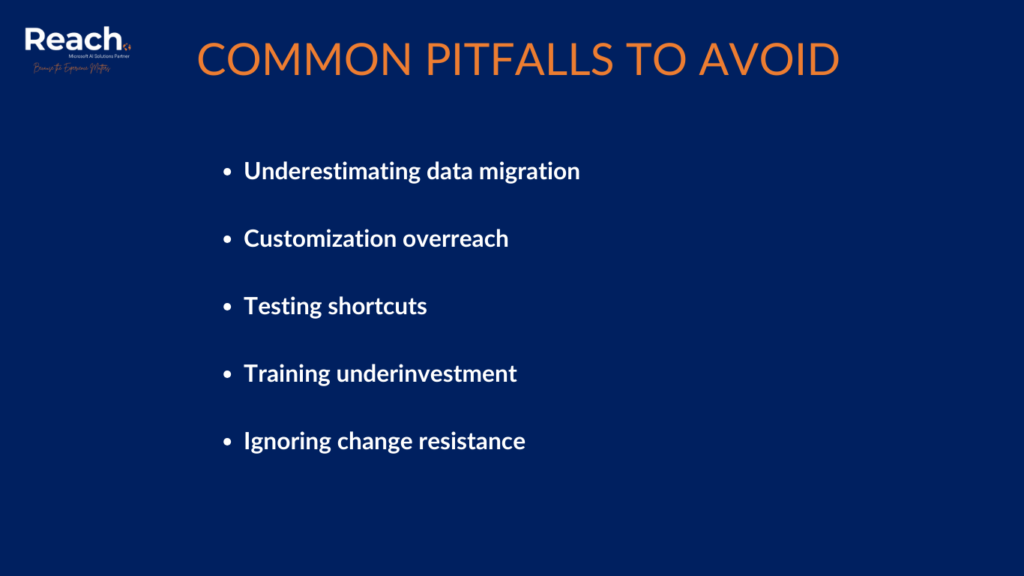
Common Pitfalls to Avoid
Underestimating Data Migration
Data migration typically consumes 25-30% of implementation effort. Start early, plan multiple iterations, and expect data quality issues that take time to resolve.
Customization Overreach
D365 Finance is highly configurable. Use configuration before customization. Customization creates upgrade challenges and ongoing maintenance burden.
Testing Shortcuts
When timelines get tight, testing often gets compressed. This is a mistake. Inadequate testing leads to post-go-live issues that are more expensive to fix than delayed go-live.
Training Underinvestment
A well-configured system that users don’t understand delivers no value. Budget adequate time and resources for training.
Ignoring Change Resistance
Some people will resist the new system. Address resistance directly rather than hoping it goes away. Understand concerns, involve resisters in the process, and demonstrate benefits.
Conclusion
D365 Finance implementation for investment managers is a significant undertaking, but it’s a well-understood path. Success comes from realistic planning, adequate resources, disciplined execution, and attention to change management.
The investment managers who get the most value from D365 Finance are those who treat implementation as a business transformation project, not just a technology project. They use the implementation as an opportunity to improve processes, not just automate existing ones.
With the right approach, you’ll emerge with a financial platform that supports your growth, simplifies your operations, and positions you for the AI-enabled future of finance.
Ready to Modernize Your Finance Operations?
Don’t let legacy systems and manual spreadsheets hold back your firm’s growth. Whether you are managing 10 entities or 100, our Finance and Supply Chain Management services are designed to help investment managers unlock the full potential of Microsoft Dynamics 365.
How We Can Help:
- Custom Implementation: Transition from manual processes to an automated, multi-entity environment tailored to PE and investment boutique needs.
- Consolidation Strategy: Design a “single source of truth” for real-time reporting across all fund families and jurisdictions.
- Managed Services: Ongoing support to ensure your system evolves alongside changing regulatory requirements and new fund launches.