
You invested in Dynamics 365 (D365) with high hopes of streamlining your business, boosting efficiency, and gaining a competitive edge. But if your implementation feels more like a never-ending saga of technical glitches, missed deadlines, and mounting frustration, it might not be the platform’s fault. Your consultant could be the weak link.
A competent D365 consultant is a crucial partner in navigating the complexities of this powerful platform. They should understand your unique business needs and translate them into a tailored D365 solution. But when this partnership falters, it can derail your entire digital transformation journey.
Let’s explore five unmistakable signs that your D365 consultant is not meeting expectations and discuss how to identify if your project is at risk.
The Reality of ERP Failure
According to Gartner, up to 75% of all ERP implementations fail to meet their original business goals. Meanwhile, McKinsey research indicates that large-scale IT projects, like Dynamics 365, typically run 45% over budget while delivering 56% less value than predicted.
These numbers reveal a hard truth: ERP failure isn’t usually caused by a software glitch. It is almost always a failure of partnership and strategy. When a D365 consultant lacks the industry-specific depth to map D365 to your actual workflows, your project becomes part of that 75% statistic—bleeding cash without delivering the promised efficiency.
If your implementation is stalling, you are likely facing the “Black Swan” risk—a term McKinsey uses for projects that spiral so far out of control (often 200–400% over budget) that they threaten the organization’s stability. Our ERP Rescue service is designed specifically to stop this bleed, realigning your D365 environment with the data-driven best practices that these studies highlight as essential for recovery.
5 Signs Your D365 Consultant is Failing You
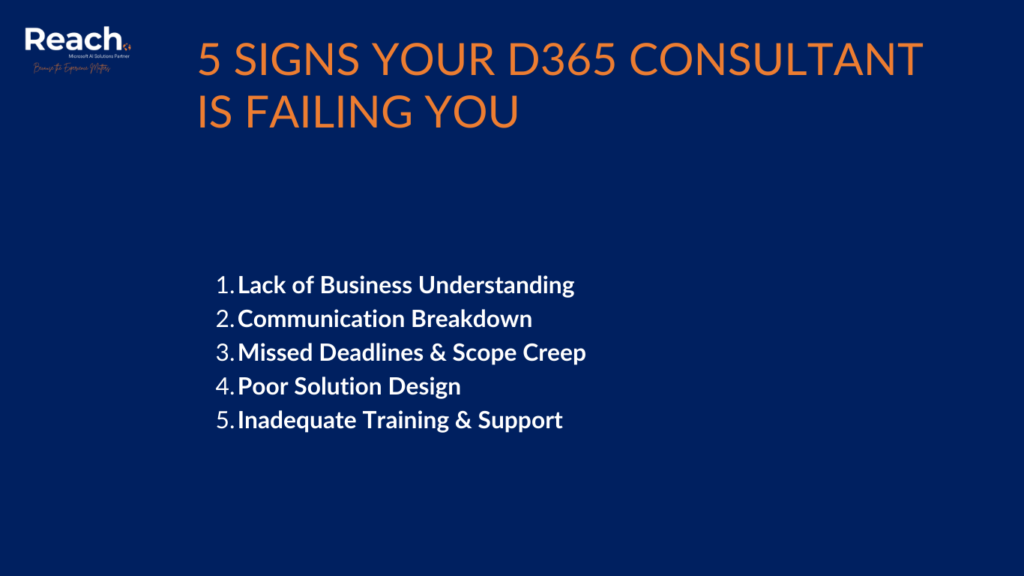
1. Lack of Business Understanding:
Your D365 solution should be aligned with your specific business goals, not just a standard out-of-the-box configuration. A failing D365 consultant often jumps straight into the technicalities without truly understanding your processes, challenges, and aspirations. They may propose features that aren’t relevant to your operations, leading to a system that’s difficult to use and doesn’t deliver the expected value.
2. Communication Breakdown:
Regular and open communication is essential for a successful D365 implementation. A failing D365 consultant might be unresponsive to your emails, keep you in the dark about project progress, or provide vague and confusing updates. They might also fail to clearly communicate potential risks and challenges, leaving you unprepared for problems when they arise.
3. Missed Deadlines and Scope Creep:
While some unforeseen delays are inevitable, consistent missed deadlines are a red flag. A failing D365 consultant may struggle to manage project timelines effectively, underestimate the effort required for certain tasks, or fail to prioritize work correctly. Scope creep, the gradual expansion of project requirements without corresponding adjustments to time and budget, is another common sign of poor project management.
4. Poor Solution Design and Implementation:
The core of a successful D365 implementation is a well-designed solution. A failing D365 consultant may deliver a system that is complex, user-unfriendly, and error-prone. They might make poor architectural decisions, use outdated customization techniques, or fail to adequately test the system before deployment.
5. Inadequate Training and Support:
A successful D365 implementation doesn’t end with go-live. Your team needs proper training to effectively use the new system and ongoing support to address any issues that may arise. A failing D365 consultant may offer minimal training, leave you with inadequate documentation, or be unavailable to provide timely support.

The Cost of Failure
The consequences of a failing D365 implementation can be significant. According to McKinsey, “digital transformations often fail, with only 16 percent of respondents saying their organizations’ digital transformations have successfully improved performance and also equipped them to sustain changes in the long term.” Furthermore, Gartner states that “the majority of ERP implementations fail to deliver the expected business benefits.”
Is your D365 project facing any of these challenges? If so, it’s important to act before it’s too late.
Don’t let a poorly executed D365 implementation derail your business goals. If you’re experiencing any of these signs, consider bringing in our team of experts for an ERP rescue. We specialize in identifying the root causes of project failure and developing a recovery plan to get your D365 implementation back on track.
Yes, it’s often possible to rescue a failing D365 project. However, the sooner you address the issues, the easier and less costly it will be.
If you’re experiencing consistent missed deadlines, budget overruns, poor user adoption, technical issues, or a lack of alignment with business goals, you might need an ERP rescue.
The first step is to conduct a thorough assessment of your current D365 project to identify the root causes of failure. This will involve reviewing project documentation, interviewing stakeholders, and analyzing the system configuration.
The duration of an ERP rescue will depend on the severity of the problems and the complexity of your D365 implementation. Our experts will provide you with a detailed project plan after completing the initial assessment.
An ERP Rescue transforms a failing Dynamics 365 implementation from a financial drain into a high-performance asset by realigning technical workflows with actual business goals. This strategic intervention stops budget overruns, eliminates “fragile” customizations, and restores user confidence to ensure your D365 investment finally delivers its promised ROI.

Marketing and Sales Lead at Reach
Dan Kosanovic is a Market Leader and Dynamics 365 Expert at Reach International with extensive experience in strategic business development and client relationship management. He specializes in developing innovative marketing strategies that drive brand visibility and revenue growth. Dan successfully manages complex projects while leveraging cutting-edge technologies to optimize business processes. Dan is passionate about exploring new opportunities to help organizations improve their systems and processes through strategic partnerships and technological innovation.