
Most Dynamics 365 implementations don’t exceed budget because the technology fails. They run over because the original estimate didn’t account for realities the business didn’t know to challenge—process variation, data readiness, integrations, testing effort, and organizational change. A “reasonable” proposal can still be structurally unrealistic.
Before you approve a D365 estimate for implementation, you need to evaluate what’s missing, not just what’s priced.
This article explains how to do that—and how Reach helps organizations move fast without walking into delivery risk.
Why “Good” D365 Estimates Still Go Wrong
Organizations often evaluate estimates based on three things:
- Scope looks aligned
- Timeline feels aggressive but achievable
- Price fits the approved budget.
Unfortunately, those signals tell you almost nothing about whether the estimate is delivery‑grounded.
McKinsey’s research on ERP transformations consistently shows that cost overruns and delays are driven far more by non‑technical factors than platform choice. ERP programs stall when organizations underestimate process complexity, data preparation, governance, and change management—not because the software can’t perform.
Gartner reinforces this: by 2027, more than 70% of ERP initiatives are expected to fall short of their original business goals, primarily due to gaps in upfront planning and stakeholder alignment—not configuration mistakes.
That’s why Reach focuses on rapid but realistic implementations, grounded in upfront validation rather than optimistic assumptions.
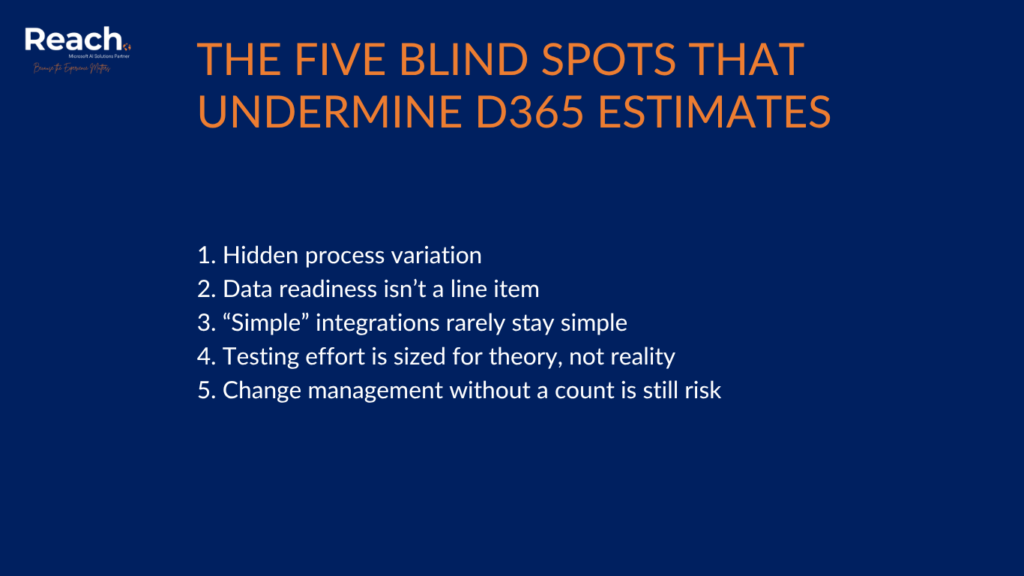
The Five Blind Spots That Undermine D365 Estimates
1. Hidden Process Variation
Most estimates assume “standardized” processes that rarely exist in practice.
What happens:
- Exceptions handled manually today aren’t documented
- Local variations exist by plant, warehouse, or business unit
- Informal approvals replace formal workflows.
Why this matters: Every undocumented exception becomes design rework, testing overhead, or a late change request.
How Reach mitigates this: Reach’s rapid implementations include early process validation workshops that surface variation before build—not during UAT.
2. Data Readiness Isn’t a Line Item (But It Should Be)
Data migration is commonly described as “straightforward” in proposals. In execution, it rarely is.
Common realities:
- Legacy data quality issues surface only during trial loads
- Ownership of data cleansing is unclear
- Historical data requirements expand mid‑project.
Reach advantage: Our rapid approach limits unnecessary historical data, defines ownership explicitly, and sizes migration effort based on evidence—not hope.
3. “Simple” Integrations Rarely Stay Simple
Integrations are often scoped as:
“Standard connector” or “light integration”
In reality:
- Upstream and downstream systems behave unpredictably
- Error handling, monitoring, and reconciliation get added late
- Performance requirements were never discussed.
Reach approach: We pressure‑test integrations early and design only what the business genuinely needs to go live—then scale.
4. Testing Effort Is Sized for Theory, Not Reality
Testing is usually underestimated because:
- Transaction volumes are assumed, not measured
- Business users’ availability isn’t factored in
- Multiple test cycles aren’t planned.
When testing compresses, defects escape—and confidence collapses.
How Reach helps: Rapid implementation doesn’t mean rushed testing. It means tightly scoped scenarios, real sample volumes, and structured validation tied to business outcomes.
5. Change Management Without a Count Is Still Risk
Many estimates reference “change management” without quantifying it.
Gartner research shows that ERP programs that treat change as an abstract concept rather than a workstream are far more likely to miss adoption targets—even if go‑live technically succeeds.
Reach’s position: We size change based on user impact, role redesign, and learning load—then prioritize what’s required for Day 1 value.
Business Central vs. Finance & Supply Chain: Why Estimates Differ
Not all D365 projects fail the same way.
| Area | Business Central | Finance & Supply Chain |
| Scope risk | Customization creep | Organizational scale |
| Data complexity | Legacy consistency | Volume & history |
| Integrations | ISVs & add‑ons | Enterprise ecosystems |
| Change load | Small teams, high dependency | Large teams, layered adoption |
Reach tailors its rapid implementation model to each platform—avoiding over‑engineering in BC and under‑estimating scale in F&SCM.
When a Phased or Assessment‑First Approach Is Safer
A fixed, full‑scope estimate isn’t wrong—but it’s not always the right starting point.
Consider a phased or assessment‑first approach when:
- Processes are only partially standardized
- Data quality is unknown
- Integrations touch mission‑critical systems
- Internal availability is limited.
McKinsey notes that organizations that front‑load clarity dramatically reduce downstream rework – even when total timelines are shorter overall.
Reach’s rapid assessments are designed exactly for this moment: move fast, but don’t guess.
How to Read a D365 Proposal Like an Informed Buyer
Before you sign, ask:
- What assumptions must be true for this estimate to hold?
- Which activities expand first if those assumptions are wrong?
- What’s deliberately excluded—and why?
If those answers aren’t explicit, risk is being transferred to you.
Ready to Move Fast Without Guessing?
A Dynamics 365 estimate shouldn’t be something you hope holds up under pressure. It should be something you understand.
Use our Estimator Tool to get a quick, customized estimate for Finance or Business Central, including:
- License cost ranges
- Implementation effort breakdown
- Industry-benchmarked guidance to reduce uncertainty early.

Ready to stop guessing costs and start planning with confidence?
Use our Dynamics 365 Estimator Tool to get a quick, delivery‑realistic estimate for your Finance or Business Central implementation.