
Introduction
“We’ve made it work.”
Finance leaders at investment managers say this constantly about their ERP systems. And it’s true. They have made it work. Through spreadsheets, manual processes, Access databases, and heroic efforts during month-end close, they’ve managed to produce financial statements, file regulatory reports, and keep the business running. So how much ERP cost?
The true is that “making it work” has costs that rarely appear on any budget line.
The Real Cost of “Making it Work”
While workaround costs are often hidden, benchmarking from top consultancy firms quantifies the impact of manual processes on modern finance functions.
- The Productivity Tax: According to McKinsey, finance professionals in organizations that have robustly adopted automation spend 20% to 30% less time on manual number crunching. For an investment manager, this translates to hundreds of hours per year redirected from “spreadsheet stitching” to strategic portfolio analysis.
- The Integration Barrier: A 2025 Gartner survey found that 47% of CFOs identify fragmented integration and manual workarounds as the primary barrier to achieving their automation goals. These “shadow functions” often require 1.3x more resources than centralized, automated processes.
- The “Spreadsheet Purgatory”: Gartner research warns that by 2026, 70% of high-performing finance organizations will have officially “ditched Excel” as their primary tool for complex financial planning and consolidation, citing it as a major driver of employee burnout.
The Workaround Inventory
Start by cataloging your current workarounds. Most investment managers are surprised by what they find.
Consolidation Workarounds:
- Excel workbooks that aggregate data from multiple entities
- Manual elimination entry journals prepared outside the system
- Currency translation calculated in spreadsheets
- Consolidation reports built in Excel from system exports.
Currency Workarounds:
- Spreadsheet calculations for unrealized gain/loss
- Manual exchange rate entry
- Reconciliation of system versus spreadsheet currency amounts
- Parallel tracking of positions in multiple currencies.
Intercompany Workarounds:
- Manual tracking of intercompany balances
- Reconciliation spreadsheets to ensure entities agree
- Manual netting and settlement calculations
- Elimination entries prepared outside the system.
Reporting Workarounds:
- Reports built in Excel because system reports don’t provide needed views
- Manual data compilation from multiple reports to get complete picture
- Analysis dimensions tracked in spreadsheets rather than system
- Board packages assembled manually from multiple sources.
Quantifying the Cost
Each workaround has costs in multiple dimensions:
Labor Hours
Map out who does what in each workaround process. How many hours per month do they spend? What’s their loaded cost?
Example: A typical consolidation workaround for a 35-entity investment manager might consume:
- 20 hours of senior accountant time preparing data exports
- 15 hours of controller time running the consolidation model
- 10 hours of various staff reconciling the results
- 5 hours of CFO review time.
At loaded costs of $75-200/hour depending on level, that’s $3,750 to $10,000 per month in consolidation workaround costs alone. $45,000 to $120,000 per year.
Multiply across all workarounds and the annual labor cost of “making it work” often exceeds $200,000 for complex firms.
Error Risk
Spreadsheet-based processes have error rates far exceeding system-based processes. Studies put spreadsheet error rates at 80-90% for non-trivial models.
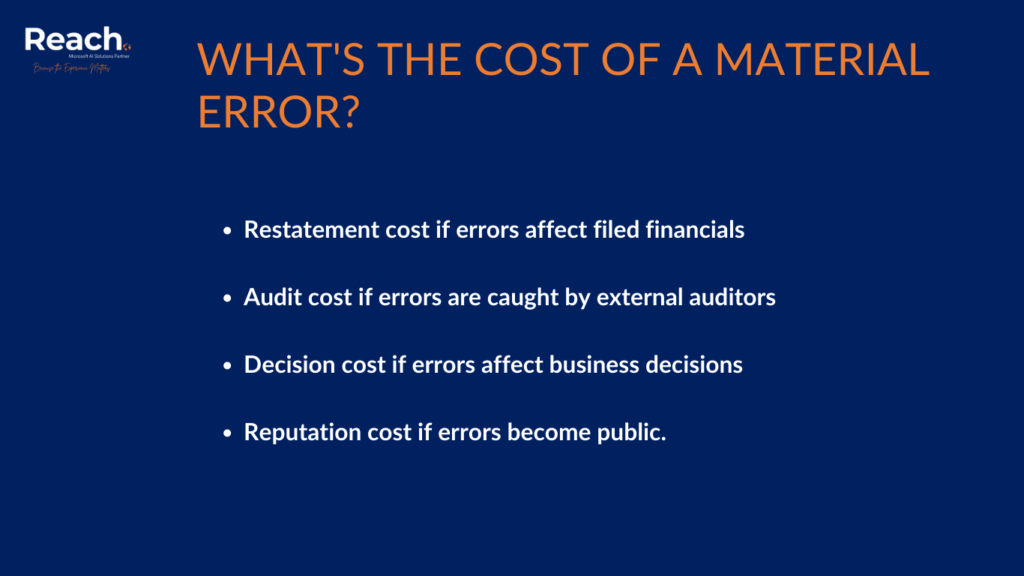
What’s the cost of a material error?
- Restatement cost if errors affect filed financials
- Audit cost if errors are caught by external auditors
- Decision cost if errors affect business decisions
- Reputation cost if errors become public.
Put probability estimates on these outcomes and calculate expected cost. Even a 2% probability of a $500,000 restatement cost yields $10,000 in expected annual risk cost.
Key Person Risk
Every workaround has an owner. What happens when they leave?
- Knowledge transfer costs
- Interim period inefficiency
- Risk of breakdown during transition
- Potential loss of institutional knowledge.
Value this as some percentage of annual salary plus recruiting and training costs for replacement.
Opportunity Cost
What could your finance team do if they weren’t maintaining workarounds?
- Better analysis to support business decisions
- Faster close cycles freeing time for forward-looking work
- Automation of other manual processes
- Support for new business initiatives.
This is the hardest cost to quantify but often the most significant.
The Scalability Ceiling
Workarounds don’t scale linearly. They scale exponentially.
When you have 25 entities, your consolidation spreadsheet has 25 tabs and associated formulas. When you acquire a new boutique and add 6 entities, you don’t add 25% complexity. You add 25% more tabs, but also more intercompany relationships (which grow combinatorially), more currency pairs, more elimination rules, and more reconciliation points.
Investment managers with aggressive growth plans often find their workaround-dependent processes become the bottleneck that constrains growth.
Building the Business Case
A solid ERP modernization business case includes:
Current State Costs:
- Labor hours on workarounds × loaded cost
- Error risk × probability
- Key person risk estimate
- Audit cost premiums attributable to manual processes.
Future State Benefits:
- Labor hour reduction
- Error risk reduction
- Audit fee reduction (firms report 10-20% audit fee reduction after ERP modernization)
- Scalability value (ability to grow without proportional finance staff growth)
- Opportunity value (what could finance team do with freed capacity).
Implementation Costs:
- Software licensing
- Implementation services
- Internal project team time
- Change management and training
- Productivity loss during transition.
Timeline:
- When does benefit start?
- How long to full adoption?
- What’s the payback period?
For complex investment managers, ERP modernization typically shows payback in 18-36 months, with positive NPV over a 7-year evaluation period at reasonable discount rates.

Conclusion
“Making it work” is a testament to the creativity and dedication of finance teams at investment managers. But workarounds have real costs in labor, risk, key person dependency, and opportunity.
Quantifying these costs often reveals that modernization isn’t just strategically attractive, it’s financially justified. The investment in modern ERP pays for itself through reduced workaround costs, lower risk, and freed capacity for higher-value work.
Ready to Modernize Your Finance Operations?
Don’t let legacy systems and manual spreadsheets hold back your firm’s growth. Whether you are managing 10 entities or 100, our Finance and Supply Chain Management services are designed to help investment managers unlock the full potential of Microsoft Dynamics 365.
How We Can Help:
- Custom Implementation: Transition from manual processes to an automated, multi-entity environment tailored to PE and investment boutique needs.
- Consolidation Strategy: Design a “single source of truth” for real-time reporting across all fund families and jurisdictions.
- Managed Services: Ongoing support to ensure your system evolves alongside changing regulatory requirements and new fund launches.
Next in this series: Blog 8: Implementation Roadmap for Investment Managers.