
Introduction
If you run finance operations at a multi-boutique investment manager or PE firm, you already know the frustration. Your current ERP was built for manufacturing companies or retail businesses. It handles inventory beautifully. It tracks widgets across warehouses with precision.
But when you need to consolidate 35 legal entities across six countries, manage nine payment currencies, and produce real-time profitability reporting by fund family, it falls apart.
This isn’t a technology problem. It’s a fit problem.
Most ERPs on the market today were designed for operational businesses with physical supply chains. Investment management firms have fundamentally different requirements: complex legal entity structures, sophisticated intercompany transactions, multi-currency operations that actually matter to the bottom line, and regulatory compliance demands that span multiple jurisdictions. Thus, ERP for investment management will have different requirements.
The Multi-Entity Challenge Nobody Talks About
Here’s what vendors don’t tell you during sales demos: managing 25 to 40 legal entities in most ERP systems becomes an administrative nightmare.
Consider a typical multi-boutique structure. You have a holding company, several boutique investment managers as subsidiaries, distribution entities in various countries, and perhaps some fund administration vehicles. Each entity might have its own functional currency. Some share a chart of accounts; others need localized structures for statutory reporting.
In legacy systems like older versions of Dynamics GP, Great Plains, or even some Tier 1 ERPs, each entity often requires a separate database or company instance. That means:
- Separate logins and user management per entity
- Manual export/import processes for consolidation
- Disconnected intercompany transaction handling
- Duplicated master data maintenance.
One investment manager we worked with recently had 45 bank accounts across 35 legal entities, operating in USD, GBP, EUR, SGD, AUD, CHF, CAD, and JPY. Their legacy system required finance staff to log into multiple company instances just to complete daily cash positioning. Month-end close stretched to three weeks because consolidation was essentially a manual spreadsheet exercise.
Currency Complexity Is More Than Exchange Rates
Investment managers don’t just deal with “foreign currency transactions” the way a manufacturing company might handle the occasional overseas purchase. Currency is embedded in every aspect of operations.
You need:
- Functional currencies that vary by legal entity based on where operations are domiciled
- Reporting currencies for consolidated financial statements (often multiple sets for different stakeholder audiences)
- Transaction currencies for actual payments and receipts
- Automatic revaluation of foreign currency balances with proper gain/loss recognition
- Historical rate tracking for specific transactions like capital contributions.
Most mid-market ERPs handle the basics: you can enter a transaction in a foreign currency and the system converts it. But investment management requires more sophistication. You need unrealized gain/loss calculations at period end. You need the ability to revalue specific account types while leaving others at historical rates. You need consolidated reporting that handles currency translation for overseas subsidiaries according to accounting standards.
The gap between “supports foreign currency” on a feature checklist and “handles investment management currency complexity in practice” is enormous.

Intercompany Isn’t Just Cost Allocation
Investment managers have intricate intercompany relationships that go far beyond simple cost allocation.
Management companies charge fees to funds. Boutiques pay distribution fees to centralized sales entities. Shared service centers allocate costs to operating companies. Capital moves between entities for regulatory requirements or operational needs.
These aren’t occasional transactions. They’re high-volume, routine activities that drive a significant portion of journal entries.
What you need from an ERP:
- Automatic due-to/due-from posting when transactions cross entity boundaries
- Intercompany elimination rules that don’t require manual adjustment
- Settlement processes that can net intercompany balances and generate actual payments
- Audit trails that satisfy regulators and external auditors.
Generic ERPs often treat intercompany as an afterthought. You post a transaction in one entity, then someone has to remember to post the corresponding entry in the related entity. Eliminations happen in a consolidation spreadsheet rather than in the system.
Regulatory Compliance Isn’t Optional
Investment managers operate under regulatory scrutiny that most businesses never experience. SOX compliance, SOC audits, GDPR, multiple regulatory filings across jurisdictions, and increasing focus on operational resilience all create demands on financial systems.
An ERP for investment management needs:
- Comprehensive audit trails on every transaction and master data change
- Role-based security that enforces segregation of duties
- Workflow approvals that route documents based on amount thresholds and approval hierarchies
- Data residency options for GDPR and similar regulations
- Retention and purging capabilities that align with regulatory requirements.
When auditors arrive, they want to see who approved what, when approvals happened, and whether the system enforced the controls your policies describe. They want to trace a transaction from source document to financial statement and back. If your ERP can’t demonstrate that, you have a finding.
What the Data Says: The Cost of Inefficiency
Recent industry research highlights that the “manual workaround” culture common in investment management is reaching a breaking point.
Gartner reports that 70% of finance leaders cite inefficient manual processes as their primary internal challenge, with the average organization taking 12 days to complete a monthly close—double the time of top-performing firms.
Furthermore, McKinsey & Company found that in a typical finance department, nearly 50% of work is devoted to transaction processing and data reconciliation, tasks that are highly susceptible to automation. For an investment firm, this “manual tax” doesn’t just slow down reporting; it introduces significant operational risk.
What Makes D365 Finance Different
Microsoft Dynamics 365 Finance was built from the ground up for complex, multi-entity, global operations. It’s not a manufacturing ERP with bolted-on financial features.
True Multi-Entity Architecture: All legal entities exist within a single environment. Users can access multiple entities without logging in and out. Intercompany transactions automatically post both sides. Consolidation happens in real-time.
Native Financial Dimensions: Beyond the chart of accounts, financial dimensions let you analyze data across any business structure. Track profitability by boutique, fund family, cost center, department, and any other dimension relevant to your business. Up to 11 dimensions per transaction without compromising system performance.
Currency That Works: Automatic exchange rate imports from external providers. Unrealized gain/loss posting on revaluation. Currency translation for consolidation with multiple rate methods. Reporting in any currency without parallel accounting structures.
Real Financial Consolidation: Online consolidation across entities in the same instance. Import consolidation for entities on different systems. Elimination rules that process automatically. Currency translation that follows accounting standards.
Compliance Built In: Workflow for every process. Audit trails on every transaction. Role-based security with segregation of duties enforcement. Electronic signatures and approval history.
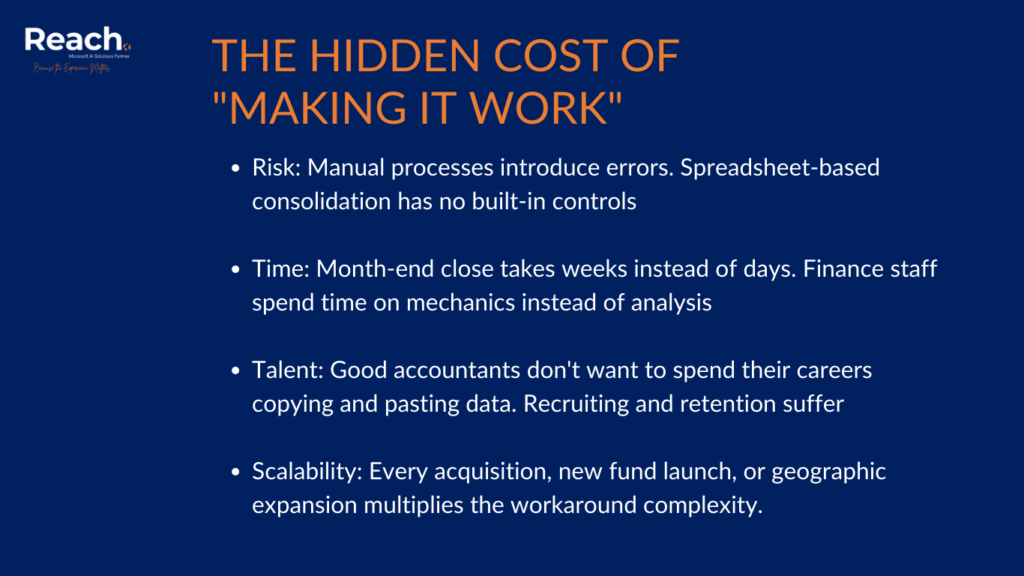
The Hidden Cost of “Making It Work”
Many investment managers have spent years customizing, extending, and working around ERP limitations. They’ve built Access databases to track what the ERP can’t. They’ve created elaborate Excel models for consolidation. They have people whose entire job is manually moving data between systems.
These workarounds have real costs:
- Risk: Manual processes introduce errors. Spreadsheet-based consolidation has no built-in controls
- Time: Month-end close takes weeks instead of days. Finance staff spend time on mechanics instead of analysis
- Talent: Good accountants don’t want to spend their careers copying and pasting data. Recruiting and retention suffer
- Scalability: Every acquisition, new fund launch, or geographic expansion multiplies the workaround complexity.
At some point, the accumulated technical debt becomes unsustainable. The question isn’t whether to modernize, but when.
Evaluating Your Options
When evaluating ERP options for an investment management firm, dig beyond feature checklists:
- Ask about entity limits. Some systems degrade significantly beyond 10-15 entities. If you have 35 today and might have 60 after acquisitions, this matters
- Test currency handling. Don’t accept “yes, we support multi-currency.” Ask for a demo of your actual scenarios: revaluation, translation, multiple reporting currencies
- Verify consolidation. Watch them consolidate entities in the demo. Is it real-time or batch? Does it require external tools? How are eliminations handled?
- Review compliance documentation. Ask for SOC reports, compliance whitepapers, and GDPR data processing agreements. If they don’t have them, that’s a red flag
- Talk to references in your industry. Generic references from manufacturing or retail companies won’t tell you what you need to know.
Conclusion
Investment management firms have outgrown the ERPs designed for simpler businesses. The operational complexity, regulatory demands, and multi-entity structures require purpose-built financial systems.
Microsoft Dynamics 365 Finance offers the architecture, functionality, and compliance capabilities that investment managers need. It’s not the only option, but it’s increasingly the choice of firms that want to stop working around their ERP and start working with it.
Ready to Modernize Your Finance Operations?
Don’t let legacy systems and manual spreadsheets hold back your firm’s growth. Whether you are managing 10 entities or 100, our Finance and Supply Chain Management are designed to help investment managers unlock the full potential of Microsoft Dynamics 365.
How We Can Help:
- Custom Implementation: Transition from manual processes to an automated, multi-entity environment tailored to PE and investment boutique needs.
- Consolidation Strategy: Design a “single source of truth” for real-time reporting across all fund families and jurisdictions.
- Managed Services: Ongoing support to ensure your system evolves alongside changing regulatory requirements and new fund launches.
Next in this series: Blog 2: Financial Consolidation for Investment Managers.